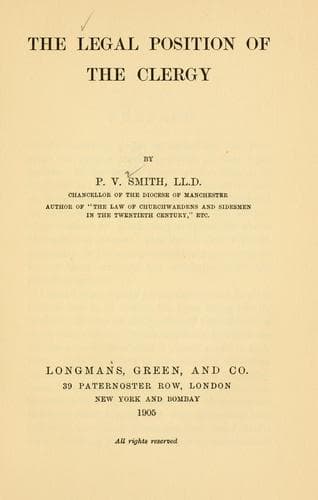
The Legal Position of the ClergySmith, Philip Vernon
Religion
The Legal Position of the Clergy
Smith, Philip Vernon
Canon law; Clergy -- Legal status, laws, etc. -- Great Britain; Ecclesiastical law -- Great Britain
_Yo. & Jer._ Younge & Jervis's Reports (Exchequer)
1826-30.
CHAPTER I
GENERAL LEGAL POSITION
1. In every country where a Christian Church is permitted to exist, the
power and authority of her clergy to exercise their functions will rest
upon a triple basis and be subject to twofold restrictions and
limitations. In the first place, (i.) they derive their spiritual
authority from their ordination, and this authority is independent of
the particular Church to which they belong. But, in the next place, they
are bound on the one hand (ii.) to obey the regulations of the Church of
which they are the ministers, and must also, on the other hand, (iii.)
conform to the laws of the country in which they labour. For they can
only actively exercise their functions by the licence or permission of
the ruling power of that country, and subject to any conditions which it
may choose to impose. These principles apply equally whether the Church
is what we call established or not. The only difference is that if the
Church is established, her own regulations are part of the law of the
land; whereas, if she is not established, the law of the land sanctions
or suffers the existence of these regulations as a private contract or
arrangement between the ministers and other members of the Church. But
even in the case of an established Church, her ministers will obviously
be restricted in the exercise of their functions by civil regulations
which do not form part of the ecclesiastical law. Thus there may be
nothing in the law of his Church to prevent a clergyman from holding a
religious service or preaching in a crowded thoroughfare. But in England
and other civilised countries any attempt to do so would be checked by
the existing laws against the obstruction of highways. In the following
pages no attempt will be made to point out the non-ecclesiastical laws
and limitations to which a parish priest is subject. For though they
necessarily affect himself and his spiritual work, they do so only
indirectly. They touch him not as a minister or even as a Christian, but
as a citizen; and they touch his spiritual work only in so far as that
work has a material and civil element.
Public-domain text, read in full here on John Shaqi.
Reviews
Reviews
No reviews yet
Be the first to share your thoughts on this work.
Join the Discussion
Join the discussion
Sign in to leave a comment or review.
Sign InorCreate an account