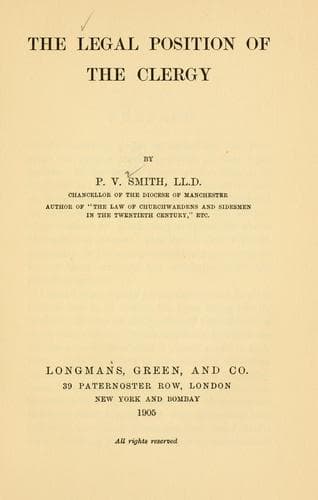
The Legal Position of the ClergySmith, Philip Vernon
Religion
The Legal Position of the Clergy
Smith, Philip Vernon
Canon law; Clergy -- Legal status, laws, etc. -- Great Britain; Ecclesiastical law -- Great Britain
2. Confining then our attention to the ecclesiastical law under which
the parish priest holds his position and acts in this country, we note
in the first place, that the Church being here established, this
ecclesiastical law is equally the law of the Church and the law of the
State. This is true whatever be its origin, and however it came into
force; and it has always had this double aspect, since (with the
exception of the brief interval of the Commonwealth--a period which is
not recognised in our jurisprudence as having had any legal existence)
there never has been a time in our history when the Church of England
has not been the Established Church of the nation. Portions of our
Church system and Church law have had an exclusively ecclesiastical
origin, by canon or otherwise, and have been adopted or acquiesced in by
the State. Further portions have been created by the joint or concurrent
action of the Church and the State. Other portions again have been due
to the sole action of the civil legislature, which has received the
tacit assent of the Church but has never been confirmed by any formal
ecclesiastical ratification. From whichever of these three sources any
particular point of our Church law may have been derived, its validity
and obligation is the same. It binds the Church and her ministers and
members irrespectively of its origin, and is at present in force unless
it has either been formally repealed or become obsolete and fallen into
desuetude.
3. Again, like our civil law, our ecclesiastical law is in part written
and in part unwritten or customary. Foreign canon or conciliar law or
papal law is only binding in England so far as it has been received by
immemorial custom, and has thus become part of our unwritten law, or
has been incorporated into our written law by the ratification of an Act
of Parliament, or a canon or constitution of our own Church; and the
binding force of the English Pre-Reformation canons, ordinances, and
provincial constitutions stands on the same footing. For the Commission
authorised by the Act for the Submission of the Clergy of 1533 to
examine the English canons and constitutions, and, with the king's
assent, declare which of them should be in force and which should be
abrogated, was never appointed, although the time for its appointment
was extended by Acts of 1535 and 1543, and the scope of its inquiry was
extended by the latter Act so as to include foreign canons and
ordinances.[1] Consequently the only written Church law is to be found
in Acts of Parliament and the Prayer-Book,[2] and in Post-Reformation
canons, which, however, except so far as they are confirmed by Act of
Parliament, or declare the unwritten law of the Church, are only binding
on the clergy.[3] Of these the chief are those known as the Canons of
1603, which were agreed upon at the sitting of the Canterbury
Convocation begun in that year, and were separately passed two years
afterwards by the York Convocation.
Public-domain text, read in full here on John Shaqi.
Reviews
Reviews
No reviews yet
Be the first to share your thoughts on this work.
Join the Discussion
Join the discussion
Sign in to leave a comment or review.
Sign InorCreate an account