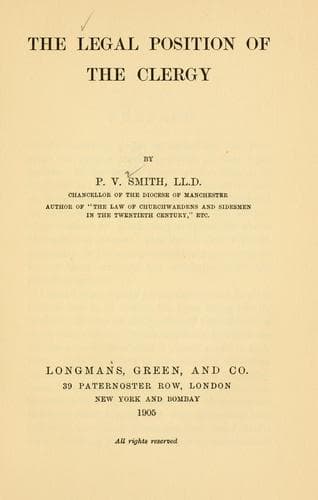
The Legal Position of the ClergySmith, Philip Vernon
Religion
The Legal Position of the Clergy
Smith, Philip Vernon
Canon law; Clergy -- Legal status, laws, etc. -- Great Britain; Ecclesiastical law -- Great Britain
6. Towards the close of Henry VIII.'s reign the monasteries were
dissolved, and their rectories and the rectorial tithes of the parishes
and other endowments attached thereto, and the right of nominating
vicars or perpetual curates to the parishes passed, with the rest of the
monastic property, in some cases into the hands of the Crown or of
private individuals who received grants of them from the Crown, while in
other cases they went to the endowment of episcopal sees or of colleges,
hospitals, or other public institutions. Whichever happened, the rectory
and rectorial tithes became thenceforth _impropriate_, and the vicar or
perpetual curate was left with the vicarial tithes and other endowments,
or a stipend, as the case might be, to serve the parish as the beneficed
parish priest. Later on, and particularly during the nineteenth century,
the growth of the population and the rapid increase of our urban
centres, owing to the steady migration from the villages to the towns,
has rendered the building of new churches and the creation of new
ecclesiastical areas a matter of pressing importance; and the same
causes have necessitated the employment in the larger parishes of
additional clergy, whether stipendiary or voluntary. In some cases an
old parish has been divided into distinct and separate parishes, each of
which has received a portion of the old church endowments, and has
become a rectory, vicarage, or perpetual curacy, according to the
_status_ of the old parish;[7] or a vicarage has been converted into a
rectory upon a surrender of the rectorial tithes by the impropriator.[8]
But, as a rule, new ecclesiastical districts or parishes have been
formed and churches built without resorting to the old endowments; and
the Church Building and New Parishes Acts provided that the ministers
put in charge of these new districts or parishes and churches should be
perpetual curates, and should, like the old rectors, vicars, and
perpetual curates, be corporations, with perpetual succession.[9] But
in 1868 it was enacted that the incumbent of every parish and new
ecclesiastical parish, who was authorised to publish banns, and
solemnise marriages, churchings, and baptisms in his church, and was not
a rector, should, for the purpose of designation only, be styled a
vicar, and his benefice should for the same purpose be styled a
vicarage.[10] The modern generic title, which includes every beneficed
parish priest, is _incumbent_. The proper and ancient term for rectors,
vicars, and all other parochial clergy, whether beneficed or
unbeneficed, is _curate_, as having the cure of souls within the
parish.[11] But in modern practice this term, when used by itself, is
generally applied to the unbeneficed or assistant curates in a parish.
Public-domain text, read in full here on John Shaqi.
Reviews
Reviews
No reviews yet
Be the first to share your thoughts on this work.
Join the Discussion
Join the discussion
Sign in to leave a comment or review.
Sign InorCreate an account