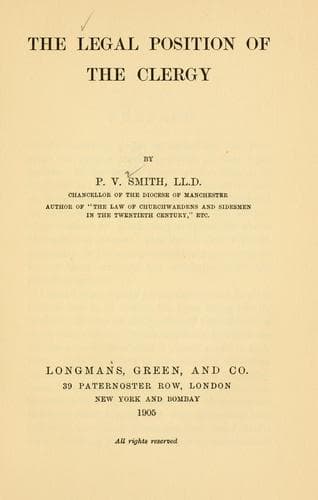
The Legal Position of the ClergySmith, Philip Vernon
Religion
The Legal Position of the Clergy
Smith, Philip Vernon
Canon law; Clergy -- Legal status, laws, etc. -- Great Britain; Ecclesiastical law -- Great Britain
5. The legal position of the parochial clergy depends for its ultimate
origin upon the legal status of the ancient _Parish_. The word is the
English form of the Greek *paroikia* (habitation), and the Latin
_parochia_, an expression originally synonymous with diocese (Gr.
*dioikêsis*, _i.e._ administration; Lat. _dioecesis_, used of a
district or part of a province in the Roman Empire), and applied to the
territory assigned to the jurisdiction of a bishop, which was served by
him and a college of clergy under him. But under Archbishop Theodore
(668-690) or shortly after his time the process was begun of encouraging
the lords of manors and great landowners to build churches for
themselves and their dependants, and devote the tithes of their manors
or estates to the maintenance of divine worship in these churches, and
the performance of religious duties among the residents on the estates.
This process was gradually extended throughout the country, and,
wherever it was adopted, the tithes were assigned either to the priest
for the time being in charge of the church, who was in that case called
the _rector_ (governor of the church) or _parson_ (Lat. _persona_)[5] or
to a monastery, the members of which were then expected to serve the
church. The manor or estate, including any detached and outlying
portions, became the parish of the church, and developed into a
territorial unit not only for ecclesiastical but also for many civil
purposes. Where the church was served by a single rector, the landowner
who had endowed it and his successors after him were given in return the
right of nominating to the bishop a clerk in Holy Orders to become
rector of the church, or, in other words, they acquired the _patronage_
or _advowson_[6] of the benefice. The frequent cases of neglect in the
service of the parish, where a monastery was rector, led, in the
thirteenth century, to the requirement that in such cases a succession
of individual priests should be appointed to discharge the duty, with a
definite portion of the endowments of the benefice as their stipend for
so doing. As a rule the great tithes, being those of corn, grain, hay,
and wood, were reserved to the monastery, and were in consequence
styled rectorial tithes, while the officiating priest, who was styled a
_vicar_, was endowed with the remaining or small tithes, which
consequently were called vicarial. But in a few instances the
officiating priest, instead of becoming entitled to the small tithes,
only received a fixed monetary stipend. Where this occurred, he was
called a _perpetual curate_. It was the rule that rectories, whether in
the hands of a monastery or a succession of individual priests, should
be endowed not only with the tithes of the parish, but also with a house
and lands, which are called glebe; and sometimes these houses and lands,
or a part of the lands, were assigned towards the stipend of the vicar.
Public-domain text, read in full here on John Shaqi.
Reviews
Reviews
No reviews yet
Be the first to share your thoughts on this work.
Join the Discussion
Join the discussion
Sign in to leave a comment or review.
Sign InorCreate an account