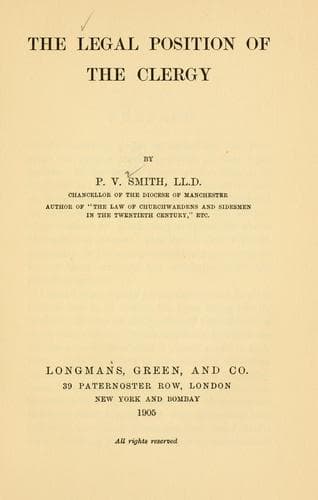
The Legal Position of the ClergySmith, Philip Vernon
Religion
The Legal Position of the Clergy
Smith, Philip Vernon
Canon law; Clergy -- Legal status, laws, etc. -- Great Britain; Ecclesiastical law -- Great Britain
13. Judicial procedure in the case of clerical offences is regulated by
three statutes of the last century: (i.) The Church Discipline Act,
1840,[22] provides that on a complaint or the existence of evil report
against a clergyman the bishop may, with the consent of the parties, at
once pronounce sentence, and, in the absence of such consent, may, if he
thinks fit, issue a commission of inquiry. If the commission reports
that there is _primâ facie_ ground for proceedings, the bishop may
either try the case in person with assessors, or else send it by
letters of request direct to the provincial court. The latter course has
in practice been generally adopted, and an appeal may be carried to the
Judicial Committee of the Privy Council. (ii.) The Public Worship
Regulation Act, 1874,[23] introduced an alternative procedure in matters
of ornament and ritual. On the representation of the archdeacon or a
churchwarden or any three parishioners, the bishop, unless he is of
opinion that no proceedings should be taken upon it, is to require the
parties to state whether they are willing to submit to his directions in
the matter, and if they assent he is to hear the case and pronounce
judgment as he thinks proper, and no appeal is to lie from his judgment.
But if they decline to submit the case to the bishop, it is to be heard
by the judge appointed under the Act, who is in fact the same person as
the judge of the two provincial courts, and an appeal lies from his
decision to the Judicial Committee. (iii.) The Clergy Discipline Act,
1892,[24] prescribed a new mode of dealing with offences against
morality. In certain cases where the offence is proved by a conviction
and sentence or an order of a temporal court, the offending clergyman is
to be incapable of holding preferment, and the bishop is to declare
vacant any preferment which he holds without any further trial. But in
all other cases proceedings are to be taken in the consistory court
before the chancellor of the diocese, with the addition of four
assessors to try any question of fact, if either party demands them.
Either party may appeal against the judgment of the consistory court on
a question of law, and the accused clergyman may, with the leave of the
appellate court, appeal on a question of fact. The appeal may at the
option of the appellant be either to the provincial court or to the
Judicial Committee of the Privy Council, but if it is made to the
provincial court the decision of that court is final. The net result of
the three Acts is that (i.) offences of the clergy in respect of
morality can only be dealt with under the Act of 1892; (ii.) proceedings
for offences in respect of ritual and the ornaments of the church or the
minister may be taken either under the Act of 1840 or under that of
1874; and (iii.) offences in respect of doctrine, as well as all other
offences which do not come under (i.) or (ii.), must be dealt with under
the Act of 1840.
Public-domain text, read in full here on John Shaqi.
Reviews
Reviews
No reviews yet
Be the first to share your thoughts on this work.
Join the Discussion
Join the discussion
Sign in to leave a comment or review.
Sign InorCreate an account