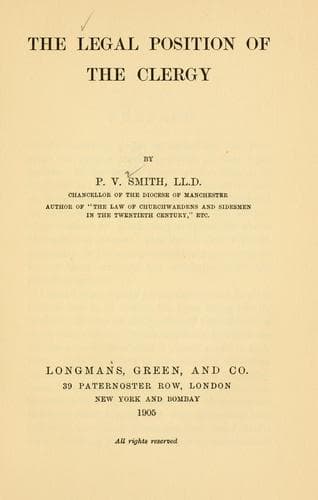
The Legal Position of the ClergySmith, Philip Vernon
Religion
The Legal Position of the Clergy
Smith, Philip Vernon
Canon law; Clergy -- Legal status, laws, etc. -- Great Britain; Ecclesiastical law -- Great Britain
14. Priests, at their ordination, are reminded of their duty to forsake
and set aside, as much as possible, all worldly cares and studies, and
are exhorted to apply themselves wholly to their sacred office, and draw
all their cares and studies that way; and they promise, among other
things, to lay aside the study of the world and the flesh. No similar
expressions occur in the form for the making of deacons; but our law
recognises no distinction between the two orders of clergy in respect
of their civil privileges and disabilities.
15. A clergyman, whether priest or deacon, is not compellable to serve
on a jury, though it is not illegal for him to do so. He may be
appointed a justice of the peace or guardian of the poor, may be a
member of a parish or district council, and may act as chairman,
alderman, or councillor of a county council, and as mayor, alderman, or
councillor of any of the Metropolitan boroughs. But he is disqualified
from being mayor, alderman, or councillor of any other municipal
borough;[25] and he cannot be elected a member of the House of
Commons;[26] though, if he is a peer, he may sit in the House of Lords.
16. Canon 75 not only forbids ecclesiastical persons to resort, except
for their honest necessities, to taverns or alehouses, or to board or
lodge therein, or to spend their time in drinking or riot or playing at
dice, cards, or tables, or any other unlawful games, but also prohibits
them from engaging in any base or servile labour. And a clergyman who
holds any cathedral preferment, benefice, curacy, or lectureship, or is
licensed or is otherwise allowed to perform the duties of any
ecclesiastical office, is subject to certain specific legal restrictions
as to engaging in business or trade. (_a_) He may not acquire for
occupation, use, or cultivation more than eighty acres of land without
the written permission of the bishop, which must be restricted to a
specified number of years not exceeding seven. (_b_) He may not engage
in any trade or dealing for profit except where it is carried on by more
than six partners, or by a company, or where the concern, or a share in
it, has devolved on him under a will or settlement, or by inheritance or
marriage or bankruptcy; and in none of the excepted cases may he act as
a director or managing partner, or carry on the concern in person. These
restrictions, however, do not extend to keeping a school or seminary, or
being employed as a schoolmaster or tutor, or being concerned in
education for profit, or buying or selling or otherwise acting in
relation to such school, seminary, or employment. Nor of course do they
prevent an incumbent from farming, if he pleases, his own glebe lands.
Nor do they interfere with the sale, even at an enhanced price, of goods
which a clergyman actually buys for the use of his household, but
afterwards does not want to keep, nor with the sale of books to or
through a bookseller or publisher. He may also be a manager, director,
Public-domain text, read in full here on John Shaqi.
Reviews
Reviews
No reviews yet
Be the first to share your thoughts on this work.
Join the Discussion
Join the discussion
Sign in to leave a comment or review.
Sign InorCreate an account