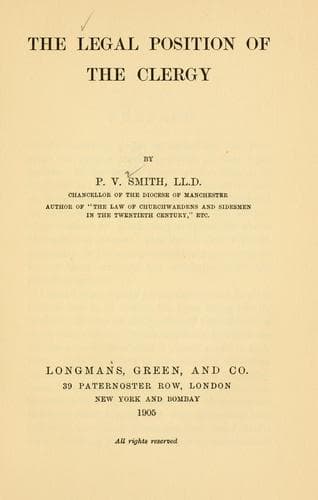
The Legal Position of the ClergySmith, Philip Vernon
Religion
The Legal Position of the Clergy
Smith, Philip Vernon
Canon law; Clergy -- Legal status, laws, etc. -- Great Britain; Ecclesiastical law -- Great Britain
[20] Phill. Eccl. Law, Pt. i. ch. v. pp. 194-207; Pt. iv. ch. xi. §3,
pp. 1051-1054; 1 Burn, 93-97. According to a table of fees settled under
the authority of the Act 30 & 31 Vict. c. 135, and published in the
_London Gazette_ of March 19, 1869, the fees to be paid by each parish
at either an episcopal or an archidiaconal visitation are 18s.; viz. 2s.
to the chancellor or archdeacon (as the case may be), 12s. 6d. to the
registrar, and 3s. 6d. to the apparitor.
[21] Ayl. Par. 205; Gibs. Cod. 971-973; 2 Burn, 119-125; Dansey's _Horæ
Decanicæ Rurales_ (2nd ed., 1844), Pts. iv, v.
[22] 3 & 4 Vict. c. 86.
[23] 37 & 38 Vict. c. 85.
[24] 55 & 56 Vict. c. 32.
[25] Cripps, 67, 68; (1882) 45 & 46 Vict. c. 50, ss. 12 (1) (_b_), 14
(3); (1888) 51 & 52 Vict. c. 41, s. 2 (2) (_a_); (1899) 62 & 63 Vict. c.
14, s. 2 (4), (5).
[26] (1801) 41 Geo. 3 (U. K.), c. 63.
[27] (1838) 1 & 2 Vict. c. 106, ss. 28, 31; (1841) 4 & 5 Vict. c. 14.
[28] (1861) 24 & 25 Vict. c. 100 (Offences against the Person), s. 36.
[29] 23 & 24 Vict. c. 32.
[30] Barnes _v._ Shore (1846) 8 Q. B. 640; 1 Rob. Eccl. 382.
[31] 33 & 34 Vict. c. 91 (The Clerical Disabilities Act, 1870).
CHAPTER II
BENEFICED CLERGY
1. In the case of all benefices, admission is granted by the bishop, as
primarily charged with the cure of souls throughout his diocese; but,
unless there is good legal reason to the contrary, he is bound to admit
the clerk who is presented by the patron of the benefice, if the
presentation is made within six calendar months after the benefice
became vacant. If that period passes without a presentation being made,
the right of appointment lapses to the bishop. If he does not appoint
within a further like period, it goes to the archbishop of the province,
and if he fails to appoint within another period of six calendar months,
it devolves finally on the Crown.[32] The period for lapse dates from
the day of the vacation of the benefice if it occurred by death or
acceptance of another living.[33] But if the vacancy was created by
resignation or deprivation or avoidance of the benefice for
non-residence, or if a clerk who is presented is rejected for want of
ability or moral character, the period will only begin to run from the
time when notice of the fact is given by the bishop to the patron,[34]
except in the case of an ecclesiastical patron who (unless the case
comes under the Benefices Act, 1898, ss. 2, 3) is not entitled to such
notice.[35] Moreover, in reckoning the period for lapse, no account is
to be taken, in the case of the first and second presentations by a
patron in respect of the same vacancy, of the time between a
presentation and the bishop's refusal to admit the presentee, or of the
period between that refusal and a decision of a court upon it, nor, in
the case of a collation by the bishop, of the time between the service
of the prescribed notice on the churchwardens and the expiration of a
Public-domain text, read in full here on John Shaqi.
Reviews
Reviews
No reviews yet
Be the first to share your thoughts on this work.
Join the Discussion
Join the discussion
Sign in to leave a comment or review.
Sign InorCreate an account