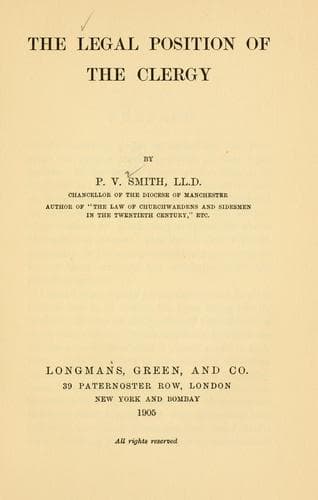
The Legal Position of the ClergySmith, Philip Vernon
Religion
The Legal Position of the Clergy
Smith, Philip Vernon
Canon law; Clergy -- Legal status, laws, etc. -- Great Britain; Ecclesiastical law -- Great Britain
month from that service.[36]
2. The original connection of advowsons or rights of presentation with
manors or estates[37] led to their passing by devolution or devise on
death, or by gift or sale during life, to the heir of the patron, or to
a devisee, donee, or purchaser of the manor or estate; and it soon
became recognised in law that they could be alienated by themselves like
any other property, apart from the manors to which they were originally
appendant. Moreover, until 1899 the law allowed a patron to grant or
sell the right of next presentation, or the right of presentation during
his lifetime, or any other limited interest in the patronage, reserving
the fee-simple of the advowson to himself. By an Act of 1713,[38] a
clergyman was prohibited from purchasing a next presentation and then
presenting himself; but this has been held not to prevent him from
presenting himself after purchasing an estate in fee, or even an estate
for life in the advowson.[39] And if the benefice is vacant at the time
of the transfer, the transfer does not carry with it the right to
present a clerk to fill up the existing vacancy.[40] This, however, was,
until 1899, frequently got over by an agreement that the transferor
should present such clerk as the transferee might nominate. But the
Benefices Act, 1898,[41] introduced several salutary restrictions on the
transfer of advowsons. Under sect. 1 of that Act:--
(_a_) A transfer of an advowson (otherwise than on marriage, death, or
bankruptcy, or on the appointment of a new trustee) is invalid unless it
(i.) transfers the whole interest of the transferor in the advowson
(except that he may reserve to himself a life interest in making a
family settlement, and the equity of redemption in making a mortgage);
(ii.) is made more than twelve months after the last filling up of the
benefice; and (iii.) is registered in the diocesan registry within one
month after its date, or such extended period as the bishop may under
special circumstances permit.
(_b_) The advowson must not be put up to auction unless sold with a
manor or not less than 100 acres of land belonging to the same owner in
the same or an adjoining parish.
Public-domain text, read in full here on John Shaqi.
Reviews
Reviews
No reviews yet
Be the first to share your thoughts on this work.
Join the Discussion
Join the discussion
Sign in to leave a comment or review.
Sign InorCreate an account