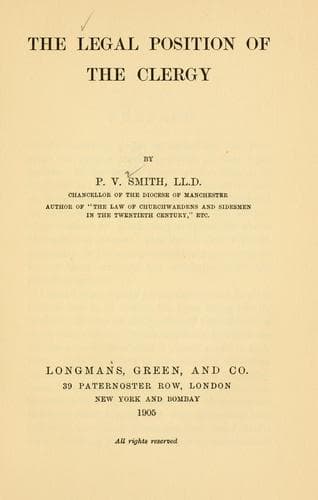
The Legal Position of the ClergySmith, Philip Vernon
Religion
The Legal Position of the Clergy
Smith, Philip Vernon
Canon law; Clergy -- Legal status, laws, etc. -- Great Britain; Ecclesiastical law -- Great Britain
2. I have not entered, nor, to the best of my knowledge and
belief, has any person entered, into any bond, covenant, or
other assurance or engagement, otherwise than as allowed by
sections one and two of the Clergy Resignation Bonds Act,
1828,[64] that I should at any time resign the said rectory (or
vicarage, &c.).
3. I have not by myself, nor, to my knowledge, has any person on
my behalf, for any sum of money, reward, gift, profit, or
advantage, or for or by means of any promise, agreement, grant,
bond, covenant, or other assurance of or for any sum of money,
reward, gift, profit, or benefit whatsoever, directly or
indirectly procured the now existing avoidance of the said
rectory (or vicarage, &c.)
4. I have not, with respect to the said presentation, been party
or privy to any agreement which is invalid under section one,
subsection three, of the Benefices Act, 1898.[65]
(iii.) The oath of allegiance, namely--
I, A. B., do swear that I will be faithful and bear true
allegiance to His Majesty King Edward the Seventh, His Heirs and
Successors according to Law. So help me GOD he oath of canonical
obedience, namely--
I, A. B., do swear that I will perform true and canonical
obedience to the Bishop of C. and his successors in all things
lawful and honest. So help me GOD.[66]
Moreover, on the first Lord's Day on which he officiates in church in
his benefice, or such other Lord's Day as the ordinary allows, he is to
read publicly the Thirty-nine Articles, and make the declaration of
assent, adding after "Articles of Religion," the words, "which I have
now read before you."[67]
7. A clerk who has been admitted to a benefice by either institution,
collation, or licence is thereby invested with the cure of souls of the
parish, and with the right to the temporalities; and, in the case of
admission by licence, nothing more is requisite to place him in full
enjoyment of the benefice. But, in the case of institution or collation,
the further process of induction is necessary to invest him with the
actual possession of its temporalities. The bishop issues his mandate
for the purpose to the archdeacon or some other person, who, in
obedience thereto, goes to the church, and, placing the clerk's hand
upon the key or ring of the door, inducts him into the real, actual, and
corporal possession of the church, with all its rights, profits, and
appurtenances.[68]
8. The following fees in connection with the admission to benefices were
settled in June 1895, under the Acts 1 & 2 Vict. c. 106, and 30 & 31
Vict. c. 135:[69]
Key for Column Z below.
A: Collation to a benefice
B: Institution to a benefice
C: Licence to a perpetual curacy
D: Induction to a benefice (whether of one parish, or of two or more
united parishes)
Public-domain text, read in full here on John Shaqi.
Reviews
Reviews
No reviews yet
Be the first to share your thoughts on this work.
Join the Discussion
Join the discussion
Sign in to leave a comment or review.
Sign InorCreate an account