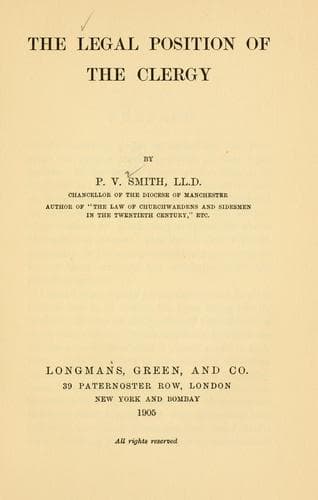
The Legal Position of the ClergySmith, Philip Vernon
Religion
The Legal Position of the Clergy
Smith, Philip Vernon
Canon law; Clergy -- Legal status, laws, etc. -- Great Britain; Ecclesiastical law -- Great Britain
5. Before the bishop admits a clerk to a vacant benefice, he must send
to the churchwardens in a registered letter a formal notice of his
intention so to do, with a statement of the ecclesiastical preferments
which the clerk has held, and a direction that the notice is to be fixed
for one month on the principal door or notice-board of the church; after
which it is to be returned to the bishop with a certificate, signed by
the churchwardens, that the direction has been complied with.[59] The
object of this proceeding is to give to the parishioners the opportunity
of communicating to the bishop the existence of any fact known to them
which would constitute a valid and legal ground for the bishop to refuse
the presentee.
6. The bishop admits a presentee by formal institution in the case of a
rectory or vicarage (the presentee kneeling before him), and by licence
in the case of a perpetual curacy. In the case of admission to the
benefices of new ecclesiastical parishes, which though by law perpetual
curacies, are titular vicarages,[60] the practice varies. Admission by
licence is the correct course; but by the desire of the presentee
himself institution is sometimes granted. Where the bishop is himself
the patron, he cannot present, and therefore admits by collation, which
corresponds to the two processes of presentation and institution.[61]
Before institution, collation, or admission by licence, the clerk makes
two declarations and takes two oaths.[62]
(i.) A declaration of assent, namely--
I assent to the Thirty-nine Articles of Religion, and to the
Book of Common Prayer, and of the ordering of Bishops, Priests,
and Deacons. I believe the Doctrine of the Church of England as
therein set forth, to be agreeable to the Word of God; and in
Public Prayer and Administration of the Sacraments I will use
the Form in the said Book prescribed and none other, except so
far as shall be ordered by lawful authority.[63]
(ii.) A declaration against simony, namely--
I, A. B., hereby solemnly and sincerely declare in reference to
the presentation made of me to the rectory (or vicarage, &c.)
of ---- as follows:
1. I have not received the presentation of the said rectory (or
vicarage, &c.) in consideration of any sum of money, reward,
gift, profit, or benefit directly or indirectly given or
promised by me, or by any person to my knowledge or with my
consent, to any person whatsoever; and I will not at any time
hereafter perform or satisfy any payment, contract, or promise
made in respect of that presentation by any person without my
knowledge or consent.
Public-domain text, read in full here on John Shaqi.
Reviews
Reviews
No reviews yet
Be the first to share your thoughts on this work.
Join the Discussion
Join the discussion
Sign in to leave a comment or review.
Sign InorCreate an account