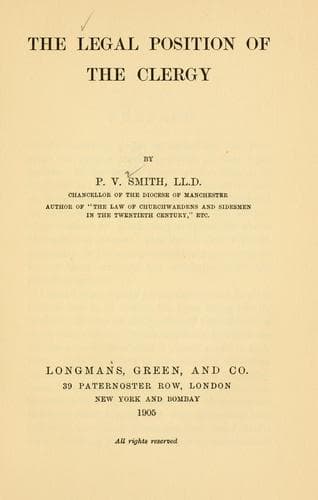
The Legal Position of the ClergySmith, Philip Vernon
Religion
The Legal Position of the Clergy
Smith, Philip Vernon
Canon law; Clergy -- Legal status, laws, etc. -- Great Britain; Ecclesiastical law -- Great Britain
[40] Alston _v._ Atlay (1837) 7 A. & E. 289.
[41] 61 & 62 Vict. c. 48.
[42] (1605) 3 Ja. 1, c. 5, ss. 19-21; (1688) 1 Will. & Mar. sess. 1, c.
26; (1898) 61 & 62 Vict. c. 48, s. 7.
[43] (1858) 21 & 22 Vict. c. 49, s. 4.
[44] 33 & 34 Vict. c. 91.
[45] 55 & 56 Vict. c. 32, ss. 1, 6.
[46] 37 & 38 Vict. c. 77. See ch. i. § 8.
[47] 27 & 28 Vict. c. 94. See ch. i. § 8.
[48] 24 Geo. 3, sess. 2, c. 35; 59 Geo. 3, c. 60; 37 & 38 Vict. c. 77,
s. 9.
[49] Willis _v._ Bp. of Oxford (1877) 2 P. D. 192. This includes, in the
four Welsh dioceses, inability to preach, administer the sacraments,
perform other pastoral duties, and converse in Welsh, subject to an
appeal to the archbishop; (1838) 1 & 2 Vict. c. 106, s. 104; Marquis of
Abergavenny _v._ Bp. of Llandaff (1888) 20 Q. B. D. 460.
[50] Ayl. Par. 39-42; Heywood _v._ Bp. of Manchester (1884) 12 Q. B. D.
404.
[51] See § 2 above.
[52] The "sufficient testimony" consists, by long-established practice,
of a testimonial by three beneficed clergymen, countersigned by the
bishops of their dioceses if they are not beneficed in the diocese of
the bishop to whom the testimonial is given, that the presentee has been
personally known to them for three years last past; that they have had
opportunities of observing his conduct, and during the whole of that
time they verily believe that he has lived piously, soberly, and
honestly, and that they have not heard anything to the contrary thereof,
nor that he has at any time held, written, or taught anything contrary
to the doctrine or discipline of the Church, and that they believe him
to be, as to his moral conduct, a person worthy to be admitted to the
benefice.
[53] Bp. of Exeter _v._ Marshall (1868) L. R. 3 H. L. 17.
[54] Gorham _v._ Bp. of Exeter (1849) 2 Rob. Eccl. 1; 13 Jur. 238.
[55] (1898) 61 & 62 Vict. c. 48, s. 3.
[56] _Ib._ s. 6 (1).
[57] _Ib._ s. 6 (2).
[58] Ayl. Par. 233-5.
[59] Benefices Act, 1898 (61 & 62 Vict. c. 48), s. 2 (2); Benefices
Rules, 1898, ru. 11, 12, sch. form (7).
[60] (1868) 31 & 32 Vict. c. 117.
[61] Gibs. Cod. 813.
[62] 28 & 29 Vict. c. 122 (Clerical Subscription Act, 1865), ss. 1, 5,
12; 31 & 32 Vict. c. 72 (Promissory Oaths Act, 1868), ss. 2, 8, 9, 14;
61 & 62 Vict. c. 48 (Benefices Act, 1898), s. 1 (4) sch.
[63] This may be the authority of the King in Council, under which the
names of the sovereign and members of the Royal Family are changed in
the prayers for them (Gibs. Cod. 280), and other forms are from time to
time prescribed; or that of the archbishop or bishop, so far as they
have power in the matter. See below, ch. v. § 1.
[64] See below, §22.
[65] See above, §2 (_c_).
[66] Clarke Proxis, tit. xci.; Gibs. Cod. 810. This oath does not mean
that the clerk will obey all the commands of the bishop against which
there is no law, but that he will obey all such commands as the bishop
by law is authorised to impose; Long _v._ Bp. of Capetown (1863) 1 Moo.
P. C. N. S. 411, at p. 465.
Public-domain text, read in full here on John Shaqi.
Reviews
Reviews
No reviews yet
Be the first to share your thoughts on this work.
Join the Discussion
Join the discussion
Sign in to leave a comment or review.
Sign InorCreate an account