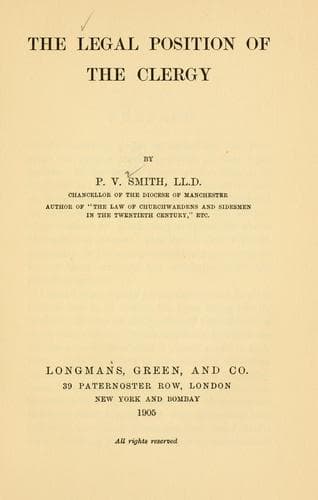
The Legal Position of the ClergySmith, Philip Vernon
Religion
The Legal Position of the Clergy
Smith, Philip Vernon
Canon law; Clergy -- Legal status, laws, etc. -- Great Britain; Ecclesiastical law -- Great Britain
24. Deprivation is either (_a_) by operation of law or (_b_) by
sentence. (_a_) It takes place _ipso facto_ (i.) if the presentation or
admission to the benefice has been simoniacal, or if a person who has
been corruptly ordained is admitted to the benefice within seven years
afterwards;[106] (ii.) if the incumbent is convicted a third time of a
breach of the provisions of the Acts of Uniformity as to using the Book
of Common Prayer and no other, and as to not preaching in derogation
thereof;[107] (iii.) if the incumbent wilfully omits to read publicly
the Thirty-nine Articles and his declaration of assent after his
admission to the benefice;[108] (iv.) if the benefice continues a whole
year under sequestration for disobedience to the bishop's monition or
order requiring the incumbent to reside on the benefice, or if he incurs
two such sequestrations within two years, and is not relieved as to
either of them on appeal;[109] (v.) if an inhibition for enforcing
obedience by the incumbent to a monition or order under the Public
Worship Regulation Act, 1874, remains in force for more than three
years, or a second inhibition for the same purpose is issued within
three years from the relaxation of a former inhibition, and the bishop
does not intervene;[110] or (vi.) in the case of an incumbent presented
or collated since 1898, if within a year after his admission his
benefice is sequestrated on his bankruptcy or in aid of an execution
against his property, or if such a sequestration, issued after that
period, continues for a year, or if he incurs two such sequestrations
within two years, unless the bishop otherwise directs.[111] Moreover
(vii.) the bishop is to declare a benefice vacant if the incumbent is
convicted of treason or felony or, on indictment, of a misdemeanour, and
is sentenced to imprisonment with hard labour or any greater punishment,
or he has a bastardy order made against him, or in a divorce or
matrimonial cause he is either found to have committed adultery or an
order for judicial separation is made against him; but if, after being
so convicted, he receives a free pardon from the Crown before the
benefice is filled up, he is to be reinstated in it.[112] (_b_) Sentence
of deprivation is pronounced in suitable cases in proceedings against an
incumbent for a serious offence against morality under the Clergy
Discipline Act, 1892, or for an offence in respect of doctrine or ritual
or other matter of ecclesiastical cognisance under the Church Discipline
Act, 1840.[113]
Footnotes
[32] Wats. ch. xii. pp. 109-120; Gibs. Cod. 768-770.
[33] Wats. ch. ii. pp. 5, 6; Gibs. Cod. 769.
[34] Wats, ch ii. p. 6; Gibs. Cod. 769; (1571) 13 Eliz. c. 12, s. 7;
(1838) 1 & 2 Vict. c. 106, s. 108.
[35] 2 Burn, 357.
[36] Benefices Act, 1898 (61 & 62 Vict. c. 48), s. 5. Comp. §§ 4, 5
below.
[37] See ch. i. § 5.
[38] 13 Ann. c. 11 (12 Ann. st. 2, c. 12), s. 2.
[39] Walsh _v._ Bp. of Lincoln (1875) L. R. 10 C. P. 518.
Public-domain text, read in full here on John Shaqi.
Reviews
Reviews
No reviews yet
Be the first to share your thoughts on this work.
Join the Discussion
Join the discussion
Sign in to leave a comment or review.
Sign InorCreate an account