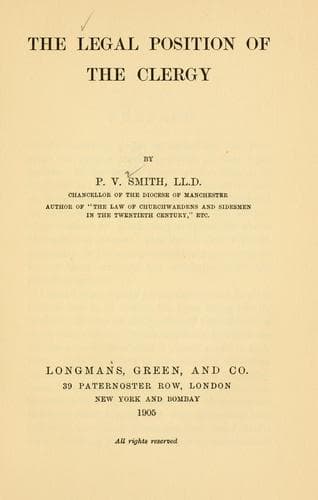
The Legal Position of the ClergySmith, Philip Vernon
Religion
The Legal Position of the Clergy
Smith, Philip Vernon
Canon law; Clergy -- Legal status, laws, etc. -- Great Britain; Ecclesiastical law -- Great Britain
Communion or to be present at public prayers according to the order of
the Church of England. When any one is so repelled, the incumbent must
report the matter to the ordinary within fourteen days, or sooner if
required by the offending person or by the ordinary himself, and must
obey his order and direction in reference to it. The rubric directs that
the ordinary shall proceed against the offender according to the Canon,
that is to say, by such ecclesiastical censures and punishments as can
be inflicted.[205] In Jenkins _v._ Cook[206] the meaning of a "common
and notorious depraver of the Book of Common Prayer" was discussed, and
the Judicial Committee of the Privy Council held that it did not include
a person who omitted certain parts of the Bible from his family reading
because he held them, in their generally received sense, to be
incompatible with religion or decency. But while they assumed that being
a depraver of the Prayer Book would be as valid a cause for denying
Communion as being an open and notorious evil liver, they did not
actually decide whether the Canons, which do not as such bind the laity,
can of their own authority prescribe causes, sufficient or lawful, for
denying Communion within the meaning of the Act of 1547.[207] It would
not be expedient in the present day for an incumbent, under Canons 28
and 57, to refuse the Communion to persons merely because they came from
outside his parish to communicate in his church instead of in their own
parish church. Nor can he lawfully refuse it to a person who
occasionally attends or even communicates in a dissenting place of
worship.[208] The question of admitting to Communion persons who have
been baptized in another communion or Christian body, and have not been
confirmed in the Church of England, is one of more difficulty. The
rubrics in the Communion Office itself are silent on the subject. But
the exhortation at the close of the Public Baptism of Infants directs
that the child shall be brought to the bishop to be confirmed without
delay after a sufficient course of instruction. The rubric at the close
of the Baptismal Service for Adults declares the expediency of every
person so baptized being confirmed by the bishop with all convenient
speed after baptism, that so he may be admitted to the Communion; and
the rubric at the end of the Order of Confirmation prescribes that there
shall none be admitted to the Communion until such time as he be
confirmed, or be ready and desirous to be confirmed. These rubrics must
be read together, and are clearly framed with a view to persons baptized
in the Church of England. In fact the Prayer Book nowhere contemplates
the case of a person who, having been validly baptized in another
communion or body, afterwards joins the Church of England, or the case
of a person belonging to some other communion who, while temporarily
resident in England, desires, without forsaking his own communion, to
communicate with his fellow Christians of our Church.
Public-domain text, read in full here on John Shaqi.
Reviews
Reviews
No reviews yet
Be the first to share your thoughts on this work.
Elsewhere in the archive
Join the Discussion
Join the discussion
Sign in to leave a comment or review.
Sign InorCreate an account