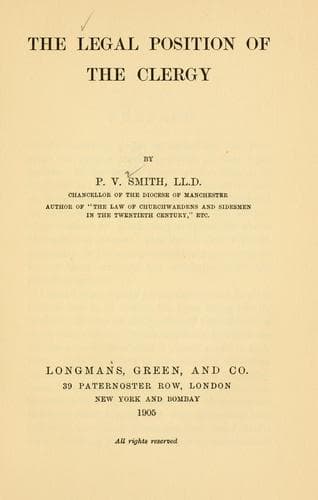
The Legal Position of the ClergySmith, Philip Vernon
Religion
The Legal Position of the Clergy
Smith, Philip Vernon
Canon law; Clergy -- Legal status, laws, etc. -- Great Britain; Ecclesiastical law -- Great Britain
1. Every person dying in this country and not within the exceptions
mentioned below (§ 3) has a common law right to be buried in the
churchyard or burial ground of the parish in which he dies, by the
clergyman of the parish.[270] Canon 67 prescribes that besides the
passing bell (see Ch. VIII. § 1 below) there shall be rung after a
person's death no more than one short peal, and one other before the
burial and one other after the burial. If he dies out of his own parish,
the persons who are responsible for his burial may claim that he be
buried in his own parish.[271] If the clergyman or the persons having
charge of the ground refuse interment, the ecclesiastical court is the
proper tribunal to give relief, and it will compel the interment. The
High Court would also compel it by mandamus.[272] But a parishioner has
no right to be buried at a particular hour or (except in the case of a
private vault or a prescriptive right to a special spot) in a particular
part of the churchyard. The incumbent can fix his own time for the
funeral, and he and the churchwardens can exercise a discretion as to
where each body shall be buried.[273] And neither incumbent nor
churchwardens, nor both together, can make a valid sale or grant to
individuals or families of a grave-space in the churchyard for their use
in perpetuity. Any such attempted transaction is worthless in point of
law. An exclusive right of burial in not more than one-sixth part of
land given as an addition to a churchyard may be reserved by the donor
to himself, his heirs, and assigns in perpetuity,[274] but with this
exception no such exclusive right can be acquired in a spot within a
churchyard except by faculty.[275] A person not a parishioner and not
dying within the parish can only be buried in the parish churchyard,
otherwise than in a private vault, by the favour and with the permission
of the incumbent and churchwardens,[276] or under a faculty obtained
from the Ecclesiastical Courts.[277]
2. As regards the burial of bodies cast up on the shore of the sea or of
any tidal or navigable water, the rights and duties are the same as if
they were the bodies of parishioners of the parish in which they were
cast up.[278]
Public-domain text, read in full here on John Shaqi.
Reviews
Reviews
No reviews yet
Be the first to share your thoughts on this work.
Elsewhere in the archive
Join the Discussion
Join the discussion
Sign in to leave a comment or review.
Sign InorCreate an account