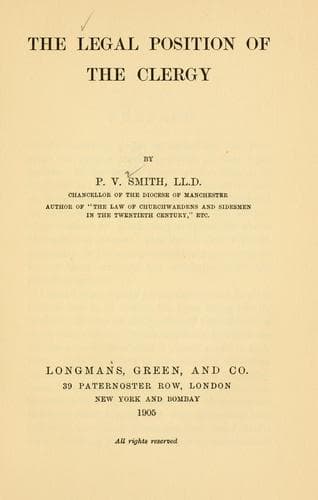
The Legal Position of the ClergySmith, Philip Vernon
Religion
The Legal Position of the Clergy
Smith, Philip Vernon
Canon law; Clergy -- Legal status, laws, etc. -- Great Britain; Ecclesiastical law -- Great Britain
3. Persons are excluded from a right to Christian burial who have not
been baptized, or die excommunicate, or have committed suicide and been
found _felo-de-se_.[279] Under the Interments (felo de se) Act,
1882,[280] the remains of a person on whom a verdict of _felo de se_ has
been passed are to be buried under the direction of the coroner in the
ground in which they would be rightfully interred if there had been no
such verdict, and in one of the ways prescribed or authorised by the
Burial Laws Amendment Act, 1880.[281] A clergyman has no right to refuse
interment with the full Burial Service to the child of a
dissenter,[282] or a person who has only received lay baptism,[283] or
has died in a state of intoxication.[284] But a refusal to bury is no
offence if the clergyman has not received convenient warning of the
intended interment.[285]
4. The incumbent may refuse to allow a corpse to be carried into
church;[286] and, in the absence of a faculty or prescriptive right, the
absolute discretion as to permitting or refusing burial under the church
itself rests, in the case of an ancient parish church, with the rector,
whether lay or spiritual, as regards the chancel, and with the incumbent
as regards the rest of the church.[287] This discretion, for sanitary
reasons, is now practically in abeyance. And no burial is permissible
beneath a church built under the Church Building Acts or within twenty
feet of its external walls.[288]
5. A clergyman cannot make the burial of a parishioner conditional on
the payment of a fee.[289] And, in cases not provided for by some local
or general statute or by a legally established table of fees, any
subsequent right to recover a fee must depend on the immemorial custom
of the particular parish.[290] But on the burial of non-parishioners
special fees may be previously stipulated for;[291] and the
churchwardens may by custom have a right to a portion of the fees for
the benefit of the parish or the poor.[292] In the absence of such
custom it is reasonable that part of these fees should go to the
churchwardens for the benefit of the parish; since the burial of
non-parishioners diminishes the space available for the interment of
parishioners. Except where there is an ancient custom to that effect or
under the provisions of the Burial or Cemetery Acts, no fee is payable
to the incumbent of a parish in which a person dies who is buried in
another parish.[293] The Church Building Act, 1819, enabled the Church
Building Commissioners and their successors, the Ecclesiastical
Commissioners, to fix a table of burial and other fees for a parish with
the consent of the bishop and the vestry, and also for any extra
parochial place or district chapelry or parochial chapelry,[294] but
this power is not now usually exercised. The chancellor of the diocese
is empowered and required to fix the fees for burials and other offices
in the churchyards and churches of new parishes,[295] and, sitting as
Public-domain text, read in full here on John Shaqi.
Reviews
Reviews
No reviews yet
Be the first to share your thoughts on this work.
Elsewhere in the archive
Join the Discussion
Join the discussion
Sign in to leave a comment or review.
Sign InorCreate an account