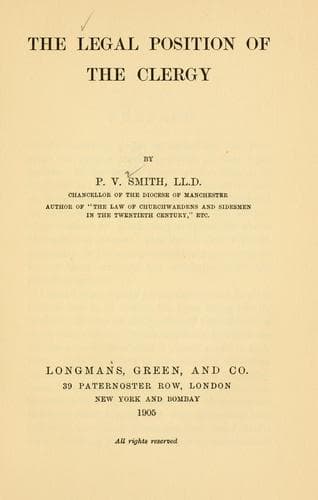
The Legal Position of the ClergySmith, Philip Vernon
Religion
The Legal Position of the Clergy
Smith, Philip Vernon
Canon law; Clergy -- Legal status, laws, etc. -- Great Britain; Ecclesiastical law -- Great Britain
ordinary in the consistory court, he can prescribe the fees to be
demanded in an ancient parish for any matter connected with burial which
is in excess of the bare common law right of burial, as, for instance,
for the privilege of being buried in a brick vault or in an iron
coffin.[296] Where a new ecclesiastical parish is formed, and has a
churchyard or burial ground, either of its own, or in which its
residents have a right to be interred, whether provided ecclesiastically
or by a burial authority, it becomes for the purposes of burial a
distinct parish from the mother parish, so that the residents in each
have no rights of burial in the churchyard or burial ground of the
other, and the incumbent of the mother parish has no right to fees in
respect of interments in the churchyard or burial ground of the new
parish.[297]
6. A clergyman may use the Burial Service in unconsecrated ground,[298]
and in cases where the Burial Service is not permissible, or where the
persons responsible for the burial request it, he may use instead a
special form prescribed or approved by the ordinary.[299] On receiving
forty-eight hours' previous notice in writing to that effect from a
relative, friend, or legal representative of a deceased person entitled
to burial in a churchyard or burial ground, the incumbent of the parish
or chaplain of the ground must permit the interment of the deceased
without the performance of the rites of the Church of England, and
either without any service at all or with some other Christian and
orderly religious service conducted by a person or persons not in holy
orders of the Church of England. The notice must state the proposed day
and hour of the interment, which may be varied if inconvenient to the
person receiving the notice; and he may, on stated grounds, object
altogether to its taking place on a Sunday, Good Friday, or Christmas
Day. On every such interment the incumbent or chaplain is entitled to
the same fee, if any, as he would have received if it had been
accompanied by the Burial Service.[300]
Public-domain text, read in full here on John Shaqi.
Reviews
Reviews
No reviews yet
Be the first to share your thoughts on this work.
Elsewhere in the archive
Join the Discussion
Join the discussion
Sign in to leave a comment or review.
Sign InorCreate an account