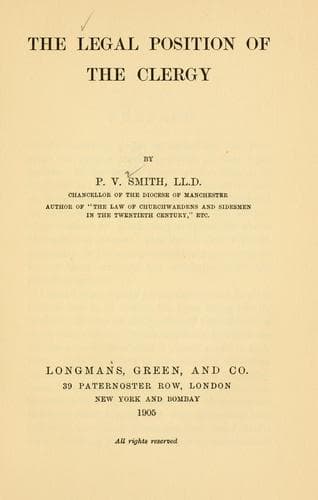
The Legal Position of the ClergySmith, Philip Vernon
Religion
The Legal Position of the Clergy
Smith, Philip Vernon
Canon law; Clergy -- Legal status, laws, etc. -- Great Britain; Ecclesiastical law -- Great Britain
7. When a clergyman performs a funeral service, the certificate of the
registrar of having registered or received notice of the death, or
(where there has been a coroner's inquest) the order of the coroner
authorising the burial, is to be delivered to him by the person who
obtained it; and a clergyman who performs a funeral service without the
delivery of such a certificate or order must, within seven days, give
written notice of the fact to the registrar of births and deaths for the
sub-district in which the death took place; and if he fails to do so, he
is liable to a penalty not exceeding £10. In the case of a burial under
the Act of 1880 (see § 6 above) the certificate or order is to be
delivered to the relative or friend or legal representative of the
deceased who has charge of or is responsible for the burial; and a
similar obligation, under a similar penalty, lies on him of giving
notice in case no certificate or order is delivered to him.[301]
8. In the case of interments in cemeteries established by special Acts
which incorporate the Cemeteries Clauses Consolidation Act, 1847,[302]
or contain similar provisions, the incumbent and clerk of the
ecclesiastical parish from which any bodies are removed for burial are
entitled to receive such fees as are prescribed by the special Act. They
are to be accounted for and paid by the cemetery company
half-yearly.[303]
9. Owing to the insufficiency of existing burial accommodation and the
importance of closing churchyards in the centres of large towns, a
series of Burial Acts, together with an Act known as the Public Health
(Interments) Act, 1879,[304] have been passed from 1852 onwards,
enabling burial boards and other local authorities to provide burial
grounds. The Acts contemplate that parts of these grounds shall be
consecrated and parts remain unconsecrated, and the earlier Acts
contemplated the erection of chapels on each of these parts. But
questions having arisen as to the amount of discretion possessed by a
local burial authority with regard to procuring the consecration of any
and what portion of a burial ground acquired by them, an Act was passed
in 1900 which, after authorising burial authorities to apply to the
bishop for the consecration of any part of their burial ground approved
by the Home Secretary, added that if a burial authority do not so apply
within a reasonable time after being requested to apply, and the Home
Secretary is satisfied that a reasonable number of persons within the
burial district desire that a portion of the ground be consecrated, and
that the consecration fees have been paid or reasonably secured, he may
himself apply to the bishop for the consecration of an approved portion
of the ground, and the bishop may consecrate it, and the burial
authority will be bound to make the necessary arrangements for the
consecration.[305] And with regard to chapels, burial authorities are
empowered to erect at their own cost, on any part of their burial ground
Public-domain text, read in full here on John Shaqi.
Reviews
Reviews
No reviews yet
Be the first to share your thoughts on this work.
Elsewhere in the archive
Join the Discussion
Join the discussion
Sign in to leave a comment or review.
Sign InorCreate an account