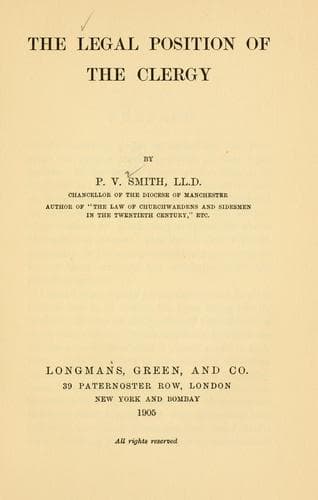
The Legal Position of the ClergySmith, Philip Vernon
Religion
The Legal Position of the Clergy
Smith, Philip Vernon
Canon law; Clergy -- Legal status, laws, etc. -- Great Britain; Ecclesiastical law -- Great Britain
"And if there be any of you whose conscience is troubled and
grieved in anything lacking comfort or counsel, let him come to
me or to some other discreet and learned priest taught in the
law of God, and confess and open his sin and grief secretly,
that he may receive such ghostly counsel, advice, and comfort
that his conscience may be relieved, and that of us (as of the
ministers of God and of the Church) he may receive comfort and
absolution to the satisfaction of his mind and avoiding of all
scruple and doubtfulness: requiring such as shall be satisfied
with a general confession not to be offended with them that do
use, to their further satisfying, the auricular and secret
confession to the priest; nor those also which think needful or
convenient, for the quietness of their own consciences,
particularly to open their sins to the priest, to be offended
with them that are satisfied with their humble confession to God
and the general confession to the Church: but in all things to
follow and keep the rule of charity, and every man to be
satisfied with his own conscience, not judging other men's minds
or consciences where as he hath no warrant of God's word to the
same."
In the present Prayer Book, all allusion to "auricular" confession is
omitted. The minister simply exhorts that if any person cannot by his
own confession to God, with full purpose of amendment of life and by
reconciliation with any neighbours whom he may have offended, quiet his
own conscience with a view to receiving Holy Communion, he should come
to the incumbent of the parish, or to some other discreet and learned
minister of God's word, and open his grief, "that by the ministry of
God's holy word he may receive the benefit of absolution together with
ghostly counsel and advice to the quieting of his conscience and
avoiding of all scruple and doubtfulness." The procedure is clearly
contemplated as exceptional, as respects (_a_) the persons who have
recourse to it, (_b_) the occasions on which they do so, and (_c_) the
sins or stumbling-blocks on which they consult the minister.
4. In addition to these more formal ministrations, a diligent clergyman
will pay frequent visits to his parishioners, and hold interviews or
correspondence with them on any questions of intellectual perplexity or
of practical difficulty in their daily life in reference to which they
may desire his counsel or assistance; but his action in these matters is
not regulated by law, and lies outside the scope of the present
treatise.
Footnote
Public-domain text, read in full here on John Shaqi.
Reviews
Reviews
No reviews yet
Be the first to share your thoughts on this work.
Elsewhere in the archive
Join the Discussion
Join the discussion
Sign in to leave a comment or review.
Sign InorCreate an account