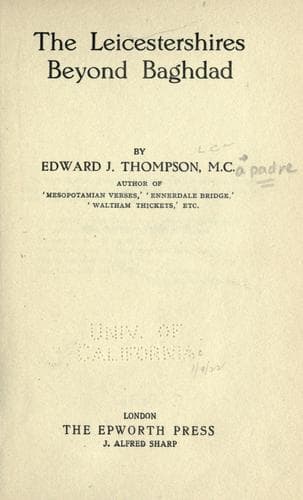
The Leicestershires beyond BaghdadThompson, Edward John
History
The Leicestershires beyond Baghdad
Thompson, Edward John
World War, 1914-1918 -- Campaigns -- Iraq
In conclusion, though the Mesopotamian War was of minor importance
beside the fighting in Western Europe, for the chronicler it has its
own advantages. If our fighting was on a smaller scale, we saw it more
clearly. The 7th Division, as I have said, usually had a campaign, with
its battles, to themselves. We were not a fractional part of an
eruption along many hundreds of miles; we were our own little volcano.
And it was the opinion of many of us that on no front was there such
comradeship; yet many had come from France, and two divisions
afterwards saw service on the Palestine front. Nor can any front have
had so many grim jokes as those with which we kept ourselves sane
through the long-drawn failure before Kut and the dragging months which
followed.
CONTENTS
CHAP. PAGE
INTRODUCTION 15
I. BELED 21
II. HARBE 48
III. THE FIRST BATTLE OF ISTABULAT 59
IV. THE BATTLE FOR SAMARRA 70
V. SUMMER AND WAITING 104
VI. HUWESLET; OR, 'THE BATTLE OF JUBER ISLAND' 120
VII. DAUR 124
VIII. AUJEH 131
IX. TEKRIT 135
X. DOWN TO BUSRA 145
INTRODUCTION
On November 6, 1914, Brigadier-General Delamaine captured Fao forts,
and the Mesopotamian War began in the smallest possible way, the
proverbial 'corporal's guard' breaking into an empire.
The next twelve months saw a great deal of fighting, unorthodox in
every way, carried through in appalling weathers and with the most
inadequate forces.
In the three days' battle at Shaiba, in April, defeat was hardly
escaped.
In April and May General Gorringe conducted the Ahwaz operations, near
the Persian border, with varying success, and threatened Amara, on the
Tigris, midway between Busra and Baghdad.
In May Townshend began his advance up-country. By June 3 he had taken
Q'urna, where Tigris and Euphrates mingle; presently his miscellaneous
marine and a handful of men took Amara, in what was known as
'Townshend's Regatta.' Seventeen guns and nearly two thousand prisoners
were taken at Amara.
In the heats of July, incredible as it sounds, Gorringe was fighting on
the Euphrates, by Nasiriyeh, taking twenty-one guns and over a thousand
prisoners.
On September 28 Townshend won his last victory at Kut-el-Amara, taking
fourteen guns and eleven hundred prisoners. Every one knows what
followed: how Ctesiphon was fought in November, with four thousand five
hundred and sixty-seven casualties, and how his force raced back to
Kut. On December 7 Kut was invested by the Turks. Townshend's stand
here saved the lower country to us.
Public-domain text, read in full here on John Shaqi.
Reviews
Reviews
No reviews yet
Be the first to share your thoughts on this work.
Join the Discussion
Join the discussion
Sign in to leave a comment or review.
Sign InorCreate an account