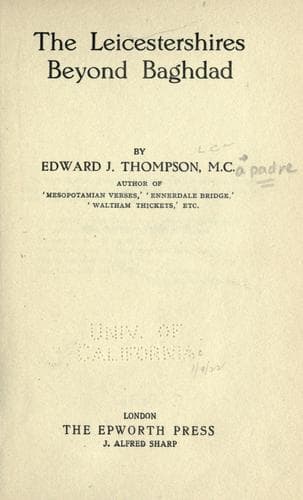
The Leicestershires beyond BaghdadThompson, Edward John
History
The Leicestershires beyond Baghdad
Thompson, Edward John
World War, 1914-1918 -- Campaigns -- Iraq
Relief forces disembarked at Ali Gharbi, between Amara and Kut, and
some of the bitterest fighting the world has seen began. Sheikh Saad
(January 6 to 8) was a costly victory. A gleam of hope came with the
Russian offensive in Northern Asia Minor. On January 13, at the Wadi,
six miles beyond Sheikh Saad and less than thirty miles from Kut, the
Turks held us up, but slipped away in the night.
All advancing was over flat ground devoid of even scrub-cover, through
a region the most desolate in the world. Above Amara there is a place
called 'Lone-Tree Village,' which has a small tree ten feet high.
Except for a handful of draggled palms at Sheikh Saad, this tree is the
only one till Kut is reached, on a river frontage of sixty miles.
On January 20 the British suffered a heavy repulse at Umm-el-Hanna,
five miles beyond the Wadi. For nearly seven weeks our troops sat down
in the swamps, and died of disease. The rains were abnormal.
On March 8 a long flank march up the right bank of the Tigris took the
enemy by surprise, and reached Dujaileh, less than ten miles from Kut.
Time was wasted in an orthodox but unnecessary bombardment. The Turks
swarmed back into the redoubt, and we were bloodily thrust back, and
returned to our lines before Hanna, with heavy losses in men and
transport. After that very few cherished any hope of saving Kut.
April was a month of terrible fighting, frontal attacks on a very brave
and exultant enemy. The 13th Division, from Gallipoli, took the Hanna
trenches, which were practically deserted, on April 5. The day went
well for us. In the afternoon Abu Roman lines on the right bank, and in
the evening those of Felahiyeh on the left bank, were carried by storm.
But next day the first of the five battles of Sannaiyat was fought. We
were repulsed.
The Turk's procedure was easy. He shot us down as we advanced over flat
country. We dug ourselves in four hundred yards away (say). Then we
sapped up to within storming distance, and attacked again, to find that
the lines were thinly held, with a machine-gun or two, but that another
position awaited us beyond, at the end of a long level sweep of desert.
On April 9 came the second battle of Sannaiyat. The time has not come
to speak frankly of this day; but our men lay in heaps. So from the
16th to the 18th we tried frontal attacks on the other bank, the right
again. This was the battle of Beit Aiessa. We did so well that the
enemy had to counter-attack, which he did in the most determined
manner, forcing us back. It cost him at least three thousand dead; but
by this day's work he made sure of Kut and its garrison. Our one hope
now was in the Russians. But their offensive halted; and we fought, on
the 22nd, the third of the Sannaiyat battles. On the 29th, after a
siege of one hundred and forty-three days, Kut surrendered, and with it
the biggest British force ever taken by any enemy.
Public-domain text, read in full here on John Shaqi.
Reviews
Reviews
No reviews yet
Be the first to share your thoughts on this work.
Join the Discussion
Join the discussion
Sign in to leave a comment or review.
Sign InorCreate an account