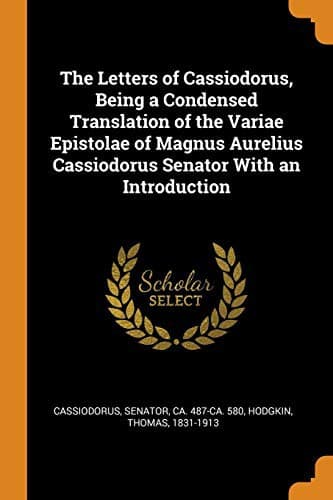
The Letters of Cassiodorus: Being a Condensed Translation of the Variae Epistolae of Magnus Aurelius Cassiodorus Senator — John Shaqi
The Letters of Cassiodorus: Being a Condensed Translation of the Variae Epistolae of Magnus Aurelius Cassiodorus SenatorCassiodorus, Senator
History
The Letters of Cassiodorus: Being a Condensed Translation of the Variae Epistolae of Magnus Aurelius Cassiodorus Senator
Cassiodorus, Senator
Goths -- Italy; Italy -- History -- 476-1268
His position, however, which was in more senses than one that of a
borderer between two worlds, gives to the study of his writings an
exceptional value. Born a few years after the overthrow of the Western
Empire, a Roman noble by his ancestry, a rhetorician-philosopher by
his training, he became what we should call the Prime Minister of the
Ostrogothic King Theodoric; he toiled with his master at the
construction of the new state, which was to unite the vigour of
Germany and the culture of Rome; for a generation he saw this edifice
stand, and when it fell beneath the blows of Belisarius he retired,
perhaps well-nigh broken-hearted, from the political arena. The
writings of such a man could hardly fail, at any rate they do not
fail, to give us many interesting glimpses into the political life
both of the Romans and the Barbarians. It is true that they throw more
light backwards than forwards, that they teach us far more about the
constitution of the Roman Empire than they do about the Teutonic
customs from whence in due time Feudalism was to be born. Still, they
do often illustrate these Teutonic usages; and when we remember that
the writer to whom after Tacitus we are most deeply indebted for our
knowledge of Teutonic antiquity, Jordanes, professedly compiled his
ill-written pamphlet from the Twelve Books of the Gothic History of
Cassiodorus, we see that indirectly his contribution to the history of
the German factor in European civilisation is a most important one.
Thus then, as has been already said, Cassiodorus stood on the confines
of two worlds, the Ancient and the Modern; indeed it is a noteworthy
fact that the very word _modernus_ occurs for the first time with any
frequency in his writings. Or, if the ever-shifting boundary between
Ancient and Modern be drawn elsewhere than in the fifth and sixth
centuries, at any rate it is safe to say, that he stood on the
boundary of two worlds, the Roman and the Teutonic.
[Sidenote: Also on the confines of Politics and Religion.]
But the statesman who, after spending thirty years at the Court of
Theodoric and his daughter, spent thirty-three years more in the
monastery which he had himself erected at Squillace, was a borderer in
another sense than that already mentioned--a borderer between the two
worlds of Politics and Religion; and in this capacity also, as the
contemporary, perhaps the friend, certainly the imitator, of St.
Benedict, and in some respects the improver upon his method,
Cassiodorus largely helped to mould the destinies of mediaeval and
therefore of modern Europe.
I shall now proceed to indicate the chief points in the life and
career of Cassiodorus. Where, as is generally the case, our
information comes from his own correspondence, I shall, to avoid
repetition, not do much more than refer the reader to the passage in
the following collection, where he will find the information given as
nearly as may be in the words of the great Minister himself.
[Sidenote: His ancestors.]
Public-domain text, read in full here on John Shaqi.
Reviews
Reviews
No reviews yet
Be the first to share your thoughts on this work.
Join the Discussion
Join the discussion
Sign in to leave a comment or review.
Sign InorCreate an account