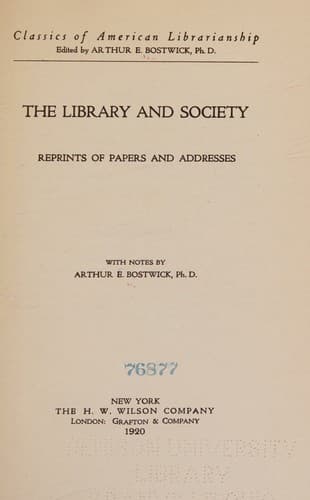
The Library and Society: Reprints of Papers and Addresses
History
The Library and Society: Reprints of Papers and Addresses
Libraries and society; Library science -- Social aspects
The Thomas Crane Library has been famous for the excellence of its
annotated catalog and for lists of books on special subjects for the use
of school children. It proposes in future to use more money than in the
past in making, printing, and keeping up to date good catalogs, and, in
order to make it practicable to do so, to keep down the number of
volumes in the library, thus reducing the expenses of cataloging, and
also to save money in housing its books. That is to say, it is acting on
the well-established principle that a small library well cataloged, if
at all adapted in the number of its volumes to the size of a town, is of
incalculably greater advantage to its constituency than one many times
larger but poorly equipped with catalogs.
It is a distinctive feature of the Quincy plan not to make the library a
special reference library. That city is very near Boston and Cambridge,
which it is well known are richly supplied with large general and
numerous special libraries.
When a man appears in Quincy who wishes to make a minute inquiry on some
special subject, it is proposed to refer him to the great libraries in
the neighboring cities, and to confine the efforts of the trustees of
the Quincy library to supplying the general wants of its constituency.
Here, then, is a bold attempt at adapting a library to its constituency.
Shall it be seconded?
Many will hold it unwise to discuss such a subject publicly. Remembering
many ill-judged efforts at economy by ignorant, uneducated, or
parsimonious men in town meetings and on library boards, they will
pronounce it hurtful to libraries to point out to such men that some
library experts consider it well to keep down expenses for cataloging
and housing books by weeding out libraries. Perhaps they are right.
Whether they are so or not, however, their objection is too late. The
matter now under consideration is undergoing public discussion, and it
is important that men having special knowledge of library matters should
contribute now the results of their experience. Unreasonable men in town
meetings and in boards of trustees must be answered, and reasonable men
and women need to understand thoroughly the subject in order that their
answers may be discriminating and wise.
Once, when the Librarian of Congress asked that an addition be made to
the library rooms, a member is said to have urged that instead of
enlarging the Capitol, the library should be weeded out. Such a plan
would be regarded generally as exceedingly foolish.
Public-domain text, read in full here on John Shaqi.
Reviews
Reviews
No reviews yet
Be the first to share your thoughts on this work.
Elsewhere in the archive
Join the Discussion
Join the discussion
Sign in to leave a comment or review.
Sign InorCreate an account