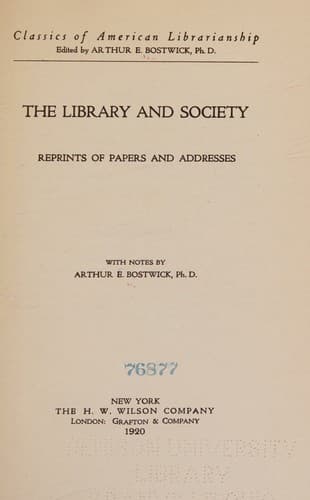
The Library and Society: Reprints of Papers and Addresses
History
The Library and Society: Reprints of Papers and Addresses
Libraries and society; Library science -- Social aspects
There must be in many parts of this broad land large and growing
libraries which will aim to gather very large general and special
collections not limited to books of intrinsic merit. Such libraries will
have to get many books of little value in themselves to enable students
to study subjects historically. It would indeed be very silly to weed
out the Congressional Library. Somewhere there should be accessible (and
where better than in that library?) every book, pamphlet, and map
published in the United States. The Congressional Library should be a
great national library like the Bibliothèque Nationale and the British
Museum.
The Quincy plan would not work well even in a place the size of
Worcester, Mass., with a population of only 90,000 or 95,000, and but 44
miles from Boston, for it is a center of important educational
institutions and of inquirers, and therefore needs large reference
libraries. Cambridge, though very much nearer Boston than Quincy,
becomes, because of Harvard University, a center where there must be a
large library. It is too great an inconvenience for Harvard professors
and students to rely, except for book rarities, on libraries even so
near as those in Boston.
On the other hand, consider the John Adams Library at Quincy. It was
collected by President John Adams in Europe and America, and undoubtedly
contains many valuable books. But is it in place in Quincy? It was
formerly kept in the Adams Academy, but not proving useful there, it was
transferred to the Thomas Crane Public Library, where it now is. Mr.
Charles Francis Adams recently said that he only knew of this John Adams
Library having been consulted once in forty years, and that then he was
himself the consulter. It is more convenient for Mr. Adams to make his
many researches in the great libraries in Boston and Cambridge than in
Quincy, and his opinion is that this library should be given to the
Boston Public Library, where it would be of great value in supplementing
the collections, and would be readily accessible to the class of
students who would use it. Perhaps, however, Quincy would be unwilling
to give up this library, which marks its connection with a very
distinguished man. While it is a distinctive feature of the Quincy plan
not to make the public library a special reference library, its success
depends on having large reference libraries near at hand. In one respect
it encourages making the library a special library, namely, on local
interests and history. As to the saving in expense possible under the
Quincy plan, while money is saved which would ordinarily be used in
housing books and in other ways, increased expenditure, it should be
remembered, is contemplated in frequent issues of improved catalogs. As
I shall soon show, the plan, if well carried out, requires other
expenditures.
There are many small libraries which do not need weeding. If a library
needs weeding, as many undoubtedly do, will it be weeded out wisely?
Public-domain text, read in full here on John Shaqi.
Reviews
Reviews
No reviews yet
Be the first to share your thoughts on this work.
Elsewhere in the archive
Join the Discussion
Join the discussion
Sign in to leave a comment or review.
Sign InorCreate an account