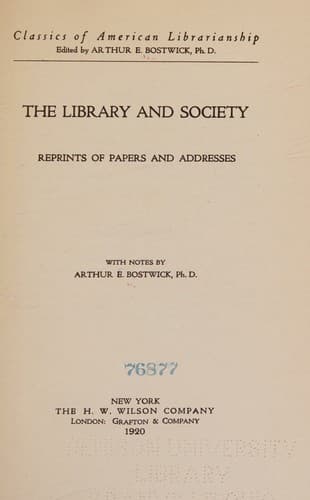
The Library and Society: Reprints of Papers and Addresses
History
The Library and Society: Reprints of Papers and Addresses
Libraries and society; Library science -- Social aspects
But as regards current light literature in general it is worth while to
consider whether the responsibility of public libraries has not been
modified by the growth and diffusion of the newspaper and periodical
press. In 1850, when the free public library was started, the number of
newspapers and periodicals published in the United States was about
2,500; now it is nearly 20,000. The total annual issues have increased
from 400 million to over 4-1/2 billion copies.
The ordinary daily of 1850 contained perhaps a single column of literary
matter. To-day it contains, for the same price, seven columns. In 1850
it gave no space to fiction; now it offers Kipling, Howells, Stockton,
Bret Harte, Anthony Hope, Crockett, Bourget and many others of the best
of the contemporary writers of fiction.
Then there are the cheap magazines, which tender a half dozen stories
for the price of a cigar or a bodkin. There are, also, the cheap
"libraries," which have flooded the United States with engaging
literature available to almost any purse.
In short, conditions have altered. A vast mass of light literature is
now cheaply accessible to the individual which formerly could be
acquired only painfully or at great expense. Why then should the public
libraries struggle to supply it in book form at the public expense?
But as to a certain percentage of current light literature there is an
embarrassment that I have not touched. It is the embarrassment of making
selection without giving offense. All cannot be bought. A choice must be
made. With reference to standard literature authoritative judgement is
not difficult to obtain. But here there has been no lapse of time to
balance opinion. An anticipatory estimate must be attempted and
attempted by the library itself.
Now, if the library decide against the book it is very likely held to
blame for "dictating" to its readers. "It is one thing," says a journal
commenting on an adverse decision, "it is one thing to consider this
novel pernicious, but it is another and more serious thing for the
foremost library in the country maintained at public expense, to deny to
a large and respectable portion of the public an opportunity to judge
for itself whether the work of a man of (this author's) calibre is
pernicious or not."
The author in this case was, of course, not Mr. X., but rather Mr. A.,
an already known quantity.
Public-domain text, read in full here on John Shaqi.
Reviews
Reviews
No reviews yet
Be the first to share your thoughts on this work.
Elsewhere in the archive
Join the Discussion
Join the discussion
Sign in to leave a comment or review.
Sign InorCreate an account