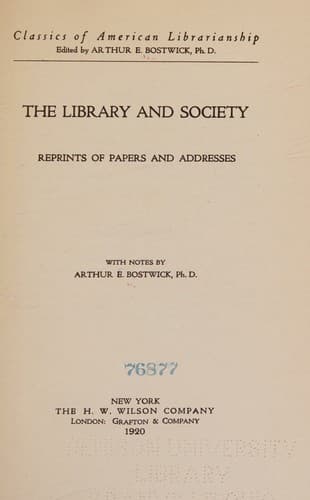
The Library and Society: Reprints of Papers and Addresses
History
The Library and Society: Reprints of Papers and Addresses
Libraries and society; Library science -- Social aspects
So a library is not to be permitted to apply a judgement of its own! It
is not protected by the fact that this judgment coincides with the
judgment of professional critics--so far at least as these may be
ascertained. The author may have turned perverse and written a book
distinctly bad. Yet this book is to be bought and supplied to enable
each member of the public to form a judgment of his own upon it. And it
is to be so bought out of public funds entrusted to the library for
educational purposes. Censorship has to us an ugly sound; but does the
library act as censor when it declares a book beyond its province? Does
it dictate what the people shall read when it says, "We decline to buy
this book for you with public funds"?
This is a question which is far larger than the selection or rejection
of a novel or two. It involves the whole question of authority, and it
concerns not merely the extremes, but the varying degrees of worth in
literature. Most departments of educational work are founded upon
principles, cautiously ascertained, and systematically adhered to. Their
consistent maintenance upon principle is the easier because each other
such department deals with a special constituency, limited either in age
or perhaps in sex, or at least in purpose, and one which accepts as
authoritative the system provided for it. The free public library,
however, has to satisfy a constituency practically unlimited, including
every age of both sexes, whose intellectual need ranges from that of the
most illiterate to that of the most highly accomplished, whose education
in books ranges from that of the person who has never entered a library
to that of the scholar whose life has been a perpetual training in the
use of the library; the assertive classes, the bashful classes. And if
toward this vast and heterogeneous constituency it seeks to assume the
position of an educator, it finds that its authority is one which the
constituents themselves are unanimously unwilling to concede. Each
constituent deems himself not a beneficiary accepting some service, but
a proprietor demanding it. Now, within each community there are persons
who would have every kind of printed matter published. If, therefore, a
public library exists simply to respond to the demands of its readers,
we must have, instead of an educational system devised by experts and
administered with reference to general principles, a system fluctuating
with each eccentric requirement of individuals, indefinite in number,
various in taste and culture, inexpert, except as each may be competent
to judge his own need, incapable of expression in the aggregate, and as
individuals without responsibility for the general results.
Public-domain text, read in full here on John Shaqi.
Reviews
Reviews
No reviews yet
Be the first to share your thoughts on this work.
Elsewhere in the archive
Join the Discussion
Join the discussion
Sign in to leave a comment or review.
Sign InorCreate an account