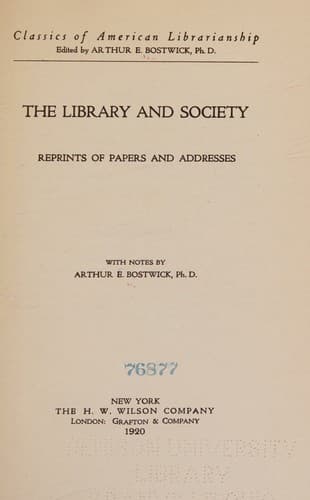
The Library and Society: Reprints of Papers and Addresses
History
The Library and Society: Reprints of Papers and Addresses
Libraries and society; Library science -- Social aspects
The monk's occupation as a librarian was gone, and he was succeeded by
the collector, the keeper, the scholar. In the centuries immediately
succeeding the invention of printing there was a growing diffusion of
knowledge by means of libraries. We smile at the restrictions imposed,
and look upon them as so many fetters on the intellect. It is, however,
to be borne in mind that at this time books were costly and rare, and on
this account were guarded with great jealousy.
When the Bodleian library was founded it was stipulated by law that
under no pretence should any book be lent to any one, no matter what his
station. A Fellow of Corpus Christi College could not enter the sacred
alcoves alone, and he was under oath not to remove a book. The books
were there for use, there can be no question; and in the Bodleian, to
which we have just referred, a person could have six books at a time to
consult, and the library was open for six hours during the day.
About 1650 Humphrey Chetham bequeathed £1,000 for a public library in
Manchester, England. He was a firm adherent of the fixed location. "My
mind and will is," he says, "that care be taken that none of said books
be taken out of the said library at any time, and that the said books be
fixed or chained." After specifying certain religious books, and
annotations on the Bible, he adds, "and other books proper for the
common people." It was two hundred years after this, in this last half
century, before the Public Libraries Act was introduced into the English
Parliament; and from this period we may date a new era, both in England
and in this country, in the dissemination of books and improved library
methods. The last decade, commencing with the formation of the A.L.A.
and the beginning of our second century as a nation, has witnessed
results hitherto unachieved in library economy. It is not necessary to
enlarge here upon the work that has been accomplished. The important
thing to note is that the librarian of to-day should be _en rapport_
with all that pertains to his profession. He should acquaint himself
with schemes of classification, and elect from them that which is best
adapted for the purposes of his own library. He should adopt the best
system for charging, acquaint himself with the most approved library
appliances. Whether he adopt the classed catalogue, the dictionary, the
alphabeto-classed, or any other form, let it be one that shall be
abreast of the progress that has been made in this department of library
science. The librarian can scarcely keep pace with his fellow-librarians
unless he receives the right hand of fellowship of the American Library
Association, and is a reader of the _Library journal_ or the _Library
notes_, just launched and designed to cruise along the coast into the
smaller ports. The advantages which the librarian receives from these
sources will qualify him better for his profession, but the greater
advantage will accrue to his readers: knowledge will be made more
Public-domain text, read in full here on John Shaqi.
Reviews
Reviews
No reviews yet
Be the first to share your thoughts on this work.
Elsewhere in the archive
Join the Discussion
Join the discussion
Sign in to leave a comment or review.
Sign InorCreate an account