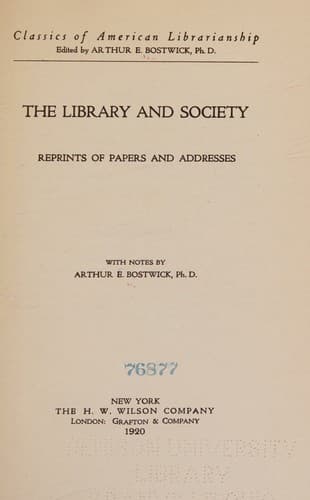
The Library and Society: Reprints of Papers and Addresses
History
The Library and Society: Reprints of Papers and Addresses
Libraries and society; Library science -- Social aspects
_Seventh_--Churches as fields for the use of surplus wealth have
purposely been reserved until the last, because, these being sectarian,
every man will be governed by his own attachments; therefore gifts to
churches, it may be said, are not, in one sense, gifts to the community
at large, but to special classes. Nevertheless, every millionaire may
know of a district where the little cheap, uncomfortable, and altogether
unworthy wooden structure stands at the cross-roads, to which the whole
neighborhood gathers on Sunday, and which is the centre of social life
and source of neighborly feeling. The administrator of wealth has made a
good use of part of his surplus if he replaces that building with a
permanent structure of brick, stone, or granite, up the sides of which
the honeysuckle and columbine may climb, and from whose tower the
sweet-tolling bell may sound. The millionaire should not figure how
cheaply this structure can be built, but how perfect it can be made. If
he has the money, it should be made a gem, for the educating influence
of a pure and noble specimen of architecture, built, as the pyramids
were built, to stand for ages, is not to be measured by dollars. Every
farmer's home, heart, and mind in the district will be influenced by the
beauty and grandeur of the church. But having given the building, the
donor should stop there; the support of the church should be upon its
own people; there is not much genuine religion in the congregation or
much good to flow from the church which is not supported at home.
Many other avenues for the wise expenditure of surplus wealth might be
indicated. I enumerate but a few--a very few--of the many fields which
are open, and only these in which great or considerable sums can be
judiciously used. It is not the privilege, however, of millionaires
alone to work for or aid measures which are certain to benefit the
community. Every one who has but a small surplus above his moderate
wants may share this privilege with his richer brothers, and those
without surplus can give at least part of their time, which is usually
as important as funds, and often more so. Some day, perhaps, with your
permission, I will endeavor to point out some fields and modes in which
these may perform well their part as trustees of wealth, or leisure,
according to the measure of their respective fortunes.
It is not expected, neither is it desirable, that there should be a
general concurrence as to the best possible use of surplus wealth. For
different men and different localities there are different uses. What
commends itself more highly to the judgment of the administrator is the
best use for him, for his heart should be in the work. It is as
important in administering wealth as it is in any other branch of a
man's work that he should be enthusiastically devoted to it and feel
that in the field selected his work lies.
Public-domain text, read in full here on John Shaqi.
Reviews
Reviews
No reviews yet
Be the first to share your thoughts on this work.
Join the Discussion
Join the discussion
Sign in to leave a comment or review.
Sign InorCreate an account