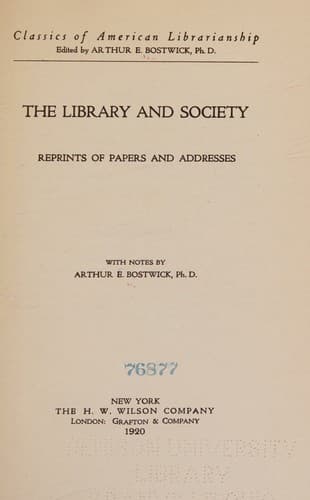
The Library and Society: Reprints of Papers and Addresses
History
The Library and Society: Reprints of Papers and Addresses
Libraries and society; Library science -- Social aspects
Besides this, there is room and need for all kinds of wise benefactions
for the common weal. The man who builds a university, library, or
laboratory performs no more useful work than he who elects to devote
himself and his surplus means to the adornment of a park, the gathering
together of a collection of pictures for the public, or the building of
a memorial arch. These are all true laborers in the vineyard. The only
point required by the "Gospel of Wealth" is that the surplus which
accrues from time to time in the hands of man should be administered by
him in his own lifetime for that purpose which is seen by him, as
trustee, to be best for the good of the people. To leave at death what
he cannot take away, and place upon others the burden of the work which
it was his own duty to perform, is to do nothing worthy. This requires
no sacrifice, nor any sense of duty to his fellows.
Time was when the words concerning the rich man entering heaven were
regarded as a hard saying. Today, when all questions are probed to the
bottom and the standards of faith received the most liberal
interpretations, the startling verse has been relegated to the rear, to
await the next kindly revision as one of those things which cannot be
quite understood, but which meanwhile--it is carefully to be
observed--are not to be understood literally. But is it so very
improbable that the next stage of thought is not to restore the doctrine
in all its pristine purity and force, as being in perfect harmony with
sound ideas upon the subject of wealth and poverty, the rich and the
poor, and the contrasts everywhere seen and deplored? In Christ's day,
it is evident, reformers were against the wealthy. It is none the less
evident that we are fast recurring to that position to-day; and there
will be nothing to surprise the student of sociological development if
society should soon approve the text which has caused so much anxiety:
"It is easier for a camel to enter the eye of a needle than for a rich
man to enter the Kingdom of Heaven." Even if the needle were the small
casement at the gates, the words betoken serious difficulty for the
rich. It will be but a step for the theologian to take from the doctrine
that he who dies rich dies disgraced to that which brings upon the man
punishment or deprivation hereafter.
Public-domain text, read in full here on John Shaqi.
Reviews
Reviews
No reviews yet
Be the first to share your thoughts on this work.
Join the Discussion
Join the discussion
Sign in to leave a comment or review.
Sign InorCreate an account