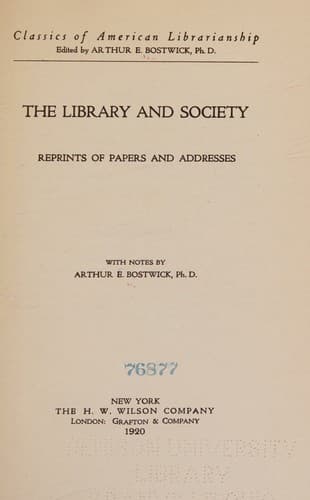
The Library and Society: Reprints of Papers and Addresses
History
The Library and Society: Reprints of Papers and Addresses
Libraries and society; Library science -- Social aspects
But before proceeding to inspect these successive forms of library
evolution, the fact should be distinctly brought out as applicable to
them all, that the American people started on their career in this
country with an uncommon interest in books; and say what one will about
American philistinism and American devotion to the practical, this
people have always retained that ancient and primitive homage for books.
To an extent, I think, unapproached elsewhere, they are, and they always
have been, a bookish people. In some other nations there is,
undoubtedly, a larger leisurely class; and among persons of that class
there is a profounder and more extensive contact with books than is the
case with us. But while among most other nations, the craving for books
is the propensity of one class, with us it may be fairly described as
the propensity of all classes. A certain tincture of bookishness has
pervaded the American people from the beginning. Perhaps the most
decided quality of American civilization has been its effort to unite
the practical with the ideal; its passion for material results ennobled
by the intellectual and the spiritual; its fine reverence for
studiousness, even amid the persistent fury of dollar-hunting.
And not only was this bookish trait visible in our colonial infancy but
it may be said to have had an ante-natal origin. The two Englishmen who
in the latter half of the 16th century did most to make possible the
birth of American civilization in the first half of the 17th, were Sir
Humphrey Gilbert and Sir Walter Raleigh; and both were men possessed by
this large zest for ideas as well as for deeds; both were contemplative
men as well as active men. The last glimpse that any surviving mortal
had of Sir Humphrey Gilbert, before his ship went down in the sea, was
of that stern hero sitting calmly on the deck, with a book in his hand,
cheering his companions by telling them that heaven is as near by water
as by land; and the last labor of Sir Walter Raleigh, before his
judicial murder in the Tower, was to write one of the learnedest and
stateliest books to be met with in the literature of modern men.
And this flavor of bookishness which belonged to these two great
pioneers and martyrs of American colonization, seems to have passed on
to the men who successfully executed the grand project in which they had
failed. When you run your eyes along the sturdy list of the great
colony-founders of the 17th century--the men who carried out the fierce
task of conveying English civilization across the Atlantic, and of
making it take root and live in this wild soil--Captain John Smith, and
William Bradford, and Winslow, and Robert Cushman, and the Winthrops,
and Dudley, and Hooker, and Davenport, and Roger Williams, and William
Penn, you will find them all, in some special sense, lovers of books,
collectors of books, readers of books, even writers of books.
Public-domain text, read in full here on John Shaqi.
Reviews
Reviews
No reviews yet
Be the first to share your thoughts on this work.
Join the Discussion
Join the discussion
Sign in to leave a comment or review.
Sign InorCreate an account