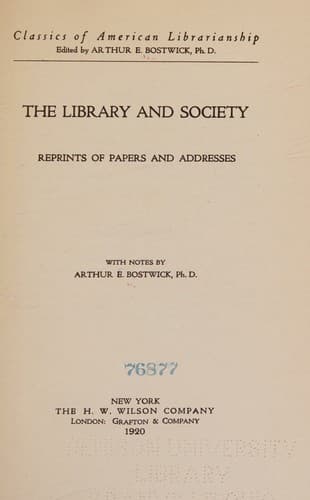
The Library and Society: Reprints of Papers and Addresses
History
The Library and Society: Reprints of Papers and Addresses
Libraries and society; Library science -- Social aspects
And what is true of the leaders of that great act of national
transmigration is true also of the men of less note who followed in it.
The first American immigrants were reading immigrants--immigrants who
brought in their hands not only axes and shovels, but books. Their
coming hither was due to the restlessness inflicted by the possession of
ideas. Books were to them a necessary part of the outfit for the voyage
and the settlement. And so rare and so precious were books in those days
that they were cherished as family treasures, and handed down as
heirlooms; nay, they were so dealt with in wills and in contracts as if
they rose almost to the dignity of real estate. In fact, in those days,
the possession of an unusual number of books, with the reputation of
using them, constituted a sort of patent of gentility, and seemed to
bridge the chasm between the most widely separated classes in society;
as when, in 1724, a young mechanic, named Benjamin Franklin, arriving in
New York on a sloop from Newport, is invited to the house of the
Governor of New York and is honored by him with a long and friendly
interview, for no other reason than that the captain of the sloop had
told the governor of a lad on his vessel who had with him "a great many
books." "The governor received me," says Franklin in his autobiography
"with great civility, showed me his library, which was a considerable
one, and we had a good deal of conversation relative to books and
authors. This was the second governor who had done me the honor to take
notice of me, and for a poor boy, like me, it was very pleasing." So I
think I am justified in saying that we started on our career as a people
with this underlying intellectual quality--a pretty general respect for
books, love for them, habit of using them; and this is the impelling
moral force which prompts to the several efforts which society has made
for providing itself with books. Now, the first stage in the process of
library evolution--and I have called it that of private libraries--was
the prevailing condition of the American colonies during the whole of
the 17th century and the first third of the 18th. This is the picture:
Everywhere books, but few, costly, portly, solemn, revered, read over
and over again; every respectable family, however poor, having at least
a few hereditary treasures in the form of books, as in that of silver
and choice furniture; and here and there up and down the colonies, an
occasional luminous spot, drawing to itself the wide-eyed wonder of the
surrounding inhabitants, the seat of a great private library, belonging
to some country gentleman, or clergyman, or publicist, like that of
Colonel William Bird, of Westover, or of the Reverend James Blair, of
Williamsburg, or of Dr. Cotton Mather, of Boston, or of James Logan, of
Philadelphia, or of Cadwallader Colden, of New York.
Public-domain text, read in full here on John Shaqi.
Reviews
Reviews
No reviews yet
Be the first to share your thoughts on this work.
Join the Discussion
Join the discussion
Sign in to leave a comment or review.
Sign InorCreate an account