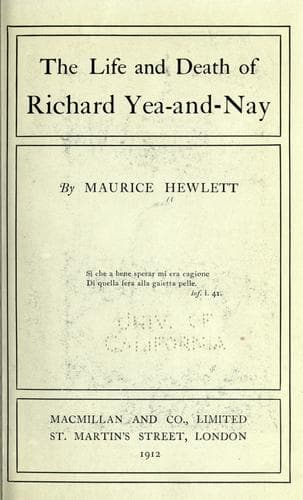
The Life and Death of Richard Yea-and-Nay — John Shaqi
The Life and Death of Richard Yea-and-NayHewlett, Maurice
General
The Life and Death of Richard Yea-and-Nay
Hewlett, Maurice
Richard I, King of England, 1157-1199 -- Fiction
The head of his house, under the Emperor Henry, was there, Conrad of
Montferrat, trying to negotiate the crown of Jerusalem. There must be a
conference before the house of Saint-Pol could be let to fall. Surely
the Marquess would never allow it! He must spike the wheel. Was not
Alois of France within the degrees? She was sister to the French King:
well, but what was Richard's mother? She had been wife to Louis, wife to
Alois' father. Was this decency? What would the Pope say--an Italian?
Was the Marquess Conrad an Italian for nothing? Was 'our cousin' the
Emperor of no account, King of the Romans? The Pope Italian, the
Marquess Italian, the Emperor on his throne, and God in His heaven--eh,
eh! there should be a conference of these high powers. So, and with such
whirl of question and answer, did the Count of Saint-Pol beat out to
Paris.
But Jehane remained at Saint-Pol-la-Marche, praying much, going little
abroad, seeing few persons. Then came (since rumour is a gadabout) Sir
Gilles de Gurdun, as she knew he would, and knelt before her, and kissed
her hand. Gilles was a square-shouldered, thick-set youth of the black
Norman sort, ruddy, strong-jawed, small-eyed, low in the brow,
bullet-headed. He was no taller than she, looked shorter, and had
nothing to say. He had loved her since the time when she was an
overgrown girl of twelve years, and he a squire about her father's house
learning mannishness. The King of England had dubbed him a knight, but
she had made him a man. She knew him to be a good one; as dull as a
mud-flat, but honest, wholesome, and of decent estate. In a moment,
when he was come again, she saw that he was a long lover who would treat
her well.
'God help me, and him also,' she thought; 'it may be that I shall need
him before long.'
CHAPTER III
IN WHAT HARBOUR THEY FOUND THE OLD LION
At Evreux, across the heath, Count Richard found his company: the
Viscount Adhémar of Limoges (called for the present the Good Viscount),
the Count of Perigord, Sir Gaston of Béarn (who really loved him), the
Bishop of Castres, and the Monk of Montauban (a singing-bird); some
dozen of knights with their esquires, pages, and men-at-arms. He waited
two days there for Abbot Milo to come up with last news of Jehane; then
at the head of sixty spears he rode fleetly over the marshes towards
Louviers. After his first, 'You are well met, my lords,' he had said
very little, showing a cold humour; after a colloquy with Milo, which he
had before he left his bed, he said nothing at all. Alone, as became one
of his race, he rode ahead of his force; not even the chirping Monk (who
remembered his brother Henry and often sighed for him) cared to risk a
shot from his strong eyes. They were like blue stones, full of the cold
glitter of their fire. It was at times like this, when a man stands
naked confronting his purpose, that one saw the hag riding on the back
of Anjou.
Public-domain text, read in full here on John Shaqi.
Reviews
Reviews
No reviews yet
Be the first to share your thoughts on this work.
Join the Discussion
Join the discussion
Sign in to leave a comment or review.
Sign InorCreate an account