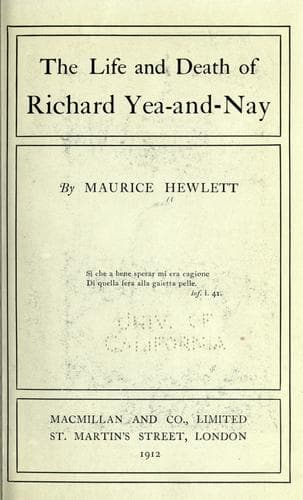
The Life and Death of Richard Yea-and-Nay — John Shaqi
The Life and Death of Richard Yea-and-NayHewlett, Maurice
General
The Life and Death of Richard Yea-and-Nay
Hewlett, Maurice
Richard I, King of England, 1157-1199 -- Fiction
He was not thinking of it now, but the truth is that there had hardly
been a time in his short life when he had not been his father's open
enemy. He could have told you that it had not been always his fault,
though he would never have told you. But I say that what he, a youth of
thirty, had made of his inheritance was as nothing to that elder's
wasting of his. In moments of hot rage Richard knew this, and justified
himself; but the melting hour came again when he heaped all reproach
upon himself, believing that but for such and such he might have loved
this rooted, terrible old man who assuredly loved not him. Richard was
neither mule nor jade; he was open to persuasion on two sides.
Compunction was one: you could touch him on the heart and bring him
weeping to his knees; affection was another: if he loved the petitioner
he yielded handsomely. Now, this time it was Jehane and not his
conscience which had sent him to Louviers. First of all Jehane had
pleaded the Sepulchre, his old father, filial obedience, and he had
laughed at the sweet fool. But when she, grown wiser, urged him to
pleasure her by treading on the heart she had given him, he could not
deny her. He was converted, not convinced. So he rode alone, three
hundred yards from his lieges, reasoning out how he could preserve his
honour and yet yield. The more he thought the less he liked it, but all
the more he felt necessity at his throat. And, as always with him, when
he thought he seemed as if turned to stone. 'One way or another,' Milo
tells us, 'every man of the House of Anjou had his unapproachable side,
so accustomed were they to the fortress-life.'
A broad plain, watered by many rivers, showed the towers of Louviers and
red roofs cinctured by the greatest of them; short of the walls were
the ranked white tents, columned smoke, waggons, with men and horses, as
purposeless, little, and busy as a swarm of bees. In the midst of this
array was a red pavilion with a standard at the side, too heavy for the
wind. All was set in the clear sunless air of an autumn day in Normandy;
the hour, one short of noon. Richard reined up for his company, on a
little hill.
'The powers of England, my lords,' he said, pointing with his hand. All
stayed beside him. Gaston of Béarn tweaked his black beard.
'Let us be done with the business, Richard,' said this knight, 'before
the irons can get out.'
'What!' cried the Count, 'shall a father smite his son?' No one
answered: in a moment he was ashamed of himself. 'Before God,' he said,
'I mean no impiety. I will do what I have undertaken as gently as may
be. Come, gentlemen.' He rode on.
Public-domain text, read in full here on John Shaqi.
Reviews
Reviews
No reviews yet
Be the first to share your thoughts on this work.
Join the Discussion
Join the discussion
Sign in to leave a comment or review.
Sign InorCreate an account