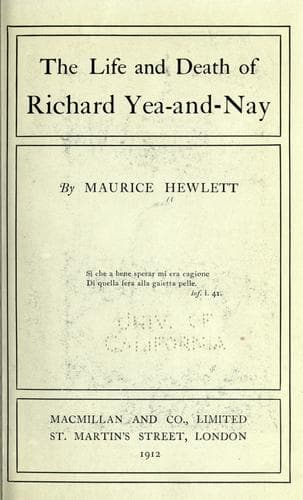
The Life and Death of Richard Yea-and-NayHewlett, Maurice
General
The Life and Death of Richard Yea-and-Nay
Hewlett, Maurice
Richard I, King of England, 1157-1199 -- Fiction
The camp was defended by fosse and bridge. At the barbican all the
Aquitanians except Richard dismounted, and all stayed about him while a
herald went forward to tell the King who was come in. The King knew very
well who it was, but chose not to know it; he kept the herald long
enough to make his visitors chafe, then sent word that the Count of
Poictou would be received, but alone. Claiming his right to ride in,
Richard followed the heralds at a foot's pace, alone, ungreeted by any.
At the mount of the standard he got off his horse, found the ushers of
the King's door, and went swiftly to the entry of the pavilion (which
they held open for him), as though, like some forest beast, he saw his
prey. There in the entry he stiffened suddenly, and stiffly went down on
his two knees. Midway of the great tent, square and rugged before him,
with working jaws and restless little fired eyes, sat the old King his
father, hands on knees, between them a long bare sword. Beside him was
his son John, thin and flushed, and about, a circle of peers: two
bishops in purple, a pock-marked monk of Cluny, Bohun, Grantmesnil,
Drago de Merlou, and a few more. On the ground was a secretary biting
his pen.
The King looked his best on a throne, for his upper part was his best.
It was, at least, the mannish part. With scanty red hair much rubbed
into disorder, a seamed red face, blotched and shining; with a square
jaw awry, the neck and shoulders of a bull; with gnarled gross hands at
the end of arms long out of measure, a cruel mouth and a nose like a
bird's beak--his features seemed to have been hacked coarsely out of
wood and as coarsely painted; but what might have passed by such means
for a man was transformed by his burning eyes, with their fuel of pain,
into the similitude of a fallen angel. The devil of Anjou sat eating
King Henry's eyes, and you saw him at his meal. It gave the man the look
of a wild boar easing his tusks against a tree, horrible, yet content to
be abhorred, splendid, because so strong and lonely. But the prospect
was not comfortable. Little as he knew of his father, Richard could make
no mistake here. The old King was in a picksome mood, fretted by rage:
angry that his son should kneel there, more than angry that he had not
knelt before.
The play began, like a farce. The King affected not to see him, let him
kneel on. Richard did kneel on, as stiff as a rod. The King talked with
obscene jocosity, every snap betraying his humour, to Prince John; he
scandalised even his bishops, he abashed even his barons. He infinitely
degraded himself, yet seemed to wallow in disgrace. So Richard's gorge
(a tender organ) rose to hear him. 'God, what wast Thou about, to let
such a hog be made?' he muttered, loud enough for at least three people
to hear. The King heard it and was pleased; the Prince heard it, and
with a scared eye perceived that Bohun had heard it. The King went
grating on, John fidgeted; Bohun, greatly daring, whispered in his
master's ear.
Public-domain text, read in full here on John Shaqi.
Reviews
Reviews
No reviews yet
Be the first to share your thoughts on this work.
Join the Discussion
Join the discussion
Sign in to leave a comment or review.
Sign InorCreate an account