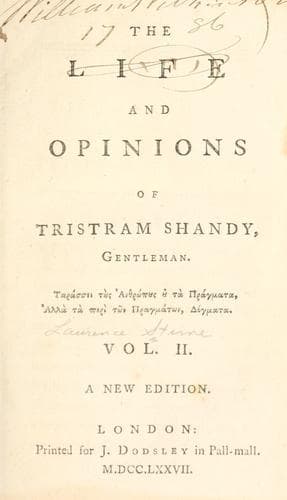
It is somewhat more, I think, the business of the critic (who is here
more especially bound not to look only at the stop-watch) to note the
far more striking way in which Sterne borrowed, not actual passages and
words, but manner and style. Here, perhaps, we shall find him accountant
for a greater debt; and here also we may think that though his genius is
indisputable, he gives more reason to those who should deny him the
highest kind of genius. Beyond doubt not merely his reading, but his
temper and his characteristics of all kinds, inclined him to the style
to which the French fifteenth and sixteenth centuries gave the name of
_fatrasie_, or pillar-to-post divagation, with more or less of a covert
satiric aim. But if we compare the dealing of Swift with Cyrano de
Bergerac, the dealing of Fielding with the romance and novel as it
existed before his time, nay, the dealing of Shakespeare with the
Marlowe drama, we shall note a marked difference in Sterne’s procedure.
Nobody, even in his own day, who knew Rabelais at all could fail to
detect the almost servile following of manner in great things and in
small which _Tristram_ displays. No one--a much smaller designation--who
knows the strange, unedifying, but very far from commonplace book of
which, as I have hinted, I never can quite believe that Beroalde de
Verville was the author, can fail to detect an even closer, though a
somewhat less obvious and, so to speak, less verifiable following here.
In another region--the purgatory of all Sterne’s commentators--we can
trace this corrupt following as distinctly at least, though it has,
I think, been less often definitely attributed. Sterne’s too celebrated
indecency, is, with one exception, _sui generis_. No doubt much nonsense
has been and is talked about “indecency” in general literature. When it
is indulged, as it has been, for instance, in French of late, it becomes
a nuisance of the most loathsome kind. It is always perhaps better left
alone. But if it be a sin to laugh now and then frankly at what were
once called “gentlemen’s stories,” then not merely many a gallant,
noble, and not unwise gentleman, but I fear not a few ladies, both fair
and fine, are damned, with Shakespeare and Scott and Southey, with
Margaret of Navarre and Marie de Sévigné, to keep them in countenance.
Yet to merit indulgence, this questionable quality, in addition to being
treated as genius treats, must have certain sub-qualities, or freedoms
from quality, of its own. It must not be brutal and inhuman, since the
quality of humanity is the main thing that saves it. It must not be
underhand and sniggering. It must be frank and jovial, or frank and
passionate. Perhaps, in some cases, it may be saved, as Swift’s is to a
great extent, by the overmastering pessimism of despair, which enforces
its contempt of man and man’s fate by bringing forward these evidences
of his weakness. But Sterne can plead none of these exemptions. He has
Public-domain text, read in full here on John Shaqi.
Reviews
Reviews
No reviews yet
Be the first to share your thoughts on this work.
Join the Discussion
Join the discussion
Sign in to leave a comment or review.
Sign InorCreate an account