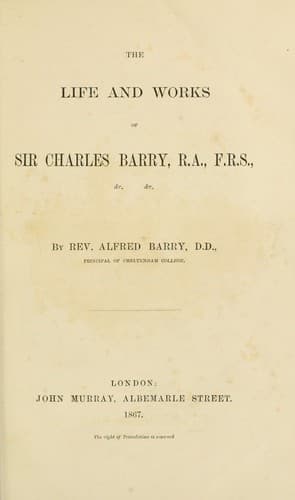
The life and works of Sir Charles BarryBarry, Alfred
General
The life and works of Sir Charles Barry
Barry, Alfred
Architects -- Great Britain -- Biography; Barry, Charles, 1795-1860
The first aid which he received from Mr. Pugin was under the pressure of
shortness of time in making the original design. Working under Mr.
Barry’s own eye and direction, Mr. Pugin sketched for him in pencil a
complete set of details, in a style perhaps bolder, less carefully
proportioned and less purely English, than would have been adopted by
himself. In the design they differed _toto cœlo_. Mr. Pugin would have
recommended irregular and picturesque grouping of parts, utterly at
variance with the regularity and symmetry actually adopted. Except in
details, he neither had, nor could have had, any influence whatever, and
those who compare the details of his own buildings with those of the New
Palace will readily see that even here his influence, however valuable,
was chiefly indirect.
As soon as he was appointed architect to the New Palace, he immediately
thought of his friend, and resolved to invite him to his aid. Convinced
that Mr. Pugin was at that time unrivalled in his knowledge of Gothic
detail, admiring his extraordinary powers as a draughtsman, carried away
by sympathy with his burning artistic enthusiasm, he could wish for no
other coadjutor. The invitation was accepted, and a connection was
established equally honourable to both artists. No man was more original
than Mr. Pugin. He held strongly certain principles, on the evolution of
which he greatly disagreed with his friend: he was one whose name and
genius could at all times command an independent authority. Yet for the
furtherance of his art he was willing to accept a distinctly subordinate
position, and to work under the superintendence and control of another.
His acceptance of the post, and the spirit in which he discharged its
duties, showed the generosity and unselfishness which were his
well-known characteristics. Nor, on the other hand, could Mr. Barry be
unaware of the danger of calling in a too powerful coadjutor. He knew
the almost inevitable risk which he incurred of being supposed to wear
other men’s laurels, of having all that was good or spirited in the
details attributed to Mr. Pugin,[81] and of finding it difficult or
impossible to control an enthusiasm, which might work in what seemed to
him undesirable methods. But these things he resolutely put aside for
the sake of an aid, which he thought likely to improve his great
building, and which he knew to be genial and inspiriting to himself.[82]
That Mr. Pugin was the last man in the world to encroach on another
man’s authority or credit he knew, and that this confidence in his
friend’s character was not misplaced is shown by the strong disclaimer
which he put out, when an attempt was made to attribute to him more than
he felt to be his due. The misapprehensions of others he could afford to
disregard.
Public-domain text, read in full here on John Shaqi.
Reviews
Reviews
No reviews yet
Be the first to share your thoughts on this work.
Elsewhere in the archive
Join the Discussion
Join the discussion
Sign in to leave a comment or review.
Sign InorCreate an account