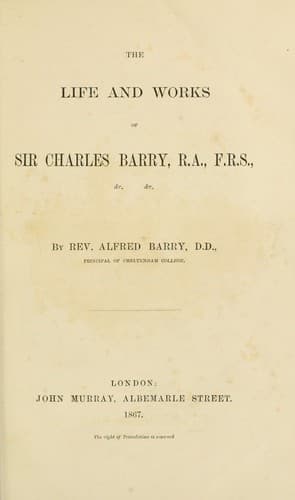
The life and works of Sir Charles BarryBarry, Alfred
General
The life and works of Sir Charles Barry
Barry, Alfred
Architects -- Great Britain -- Biography; Barry, Charles, 1795-1860
After Mr. Barry’s appointment as architect, he still received the same
aid in preparing detailed drawings for the estimate, most of which
however, by changes in design, were afterwards set aside. Finally, at
his recommendation, Mr. Pugin was formally appointed superintendent of
the wood carving, and in that capacity he directed, first the formation
of a valuable collection of plaster casts of the most famous examples at
home and abroad, and next the execution of the wood-work, ornamental
metal-work, stained glass, and encaustic tiles throughout the whole
building. But in all cases it was thoroughly understood between them,
that the architect’s supremacy was to be unimpaired. Every drawing
passed under his eye in all cases for supervision, in very many for
alteration. Mr. Pugin’s originality and enthusiasm never interfered with
this understanding: he would carry out vigorously and heartily what he
himself could not altogether approve.[83] His suggestions and
criticisms, freely given and freely received, were invaluable; and his
enthusiasm, even in its eccentricities, was inspiring and irresistible.
For more than five and twenty years the intercourse between the two
friends and coadjutors continued, unbroken by any differences except in
taste, and, when Mr. Pugin was struck down by his fatal illness, Mr.
Barry felt that his loss was irreparable.
In the stone-carving Mr. Barry was fortunate in securing aid, only less
valuable than that of Mr. Pugin. In the same work, at Birmingham, he
discovered Mr. Thomas, then working as an ordinary stone-carver on the
building. He was struck by his ability, skill, and energy, and at once
resolved to aid in raising him to a position more worthy of his
talents. After experience of his powers, he entrusted to him, under the
same supervision, the entire direction of the stone-carving throughout
the building. The result proved the wisdom of the choice. Under Mr.
Thomas’s direction, stone-carving made a great step, which was felt in
its effect upon architectural sculpture throughout the country, and
which has conduced powerfully to the remarkable progress which it has
since made up to the present time. With the general results of his
exertions Mr. Barry was fully satisfied, and rejoiced greatly when his
success in this capacity enabled him to take and to support elsewhere an
independent position.
Public-domain text, read in full here on John Shaqi.
Reviews
Reviews
No reviews yet
Be the first to share your thoughts on this work.
Elsewhere in the archive
Join the Discussion
Join the discussion
Sign in to leave a comment or review.
Sign InorCreate an account