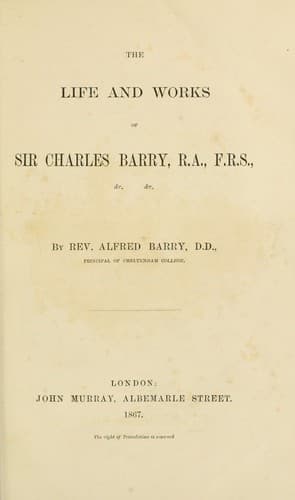
The life and works of Sir Charles BarryBarry, Alfred
General
The life and works of Sir Charles Barry
Barry, Alfred
Architects -- Great Britain -- Biography; Barry, Charles, 1795-1860
In the third place, he went on to deal with the present National
Gallery, which was, according to his scheme, after being enlarged and
remodelled, to be divided between the Royal Academy of Fine Art and the
School of Design for Practical and Decorative Art. Here again he
depended on the principle that art must be regarded as a whole, and that
“Fine Art” cannot be separated from decorative and practical art,
especially in a building, which he regarded as the home of art-teaching,
and a place for exhibition of its results, and which he accordingly
placed in a position second to none in respect of prominence and
centrality.
Fourthly, he proposed to deal with the Museum of Economic Geology, in
Jermyn Street, by removing its collection to the Temple of Science in
South Kensington, and devoting it to form a “National Polytechnic
Institution,” mainly for the use and instruction of the industrial
classes.
Lastly, the building of the Society of Arts in the Adelphi was to be
given up to meetings and lectures on all subjects connected with trade
and commerce.
Such is the outline of a scheme, to the elaboration of which he devoted
much time and trouble, and which will probably be thought to show
well-digested principle, and careful study of practicability and
convenience. It produced no effect at the time, for it opposed a plan in
which His Royal Highness was greatly interested, and in the support of
which many eminent men were already enlisted. Its author expected little
result; but such considerations seldom kept him back from bearing
testimony in the cause of his art, and so satisfying the imperious
requirements of his architectural conscience.
ROYAL ACADEMY.--In connection with these important schemes, another
fruitless design was made by Sir Charles Barry.
In 1859 the Government of Lord Derby proposed to dispossess the Royal
Academy of their present accommodation in Trafalgar Square, with a view
to that enlargement and alteration of the National Gallery, which was
felt to be inevitable. Burlington House was fixed upon, as a site which
might accommodate the Royal Academy, and certain other Institutions
which had claims upon the Crown. Messrs. Banks and Barry (of which firm
Sir Charles’s eldest son was a member), having lately gained high
distinction in the Public Offices’ competition, were appointed by the
Government to prepare general plans, showing how the entire area of
Burlington House and its gardens might be best made available. It was
ascertained that the Royal Academy would accept a portion of the site,
would conform to the general block plan, and would erect a building at
their own cost.
Public-domain text, read in full here on John Shaqi.
Reviews
Reviews
No reviews yet
Be the first to share your thoughts on this work.
Elsewhere in the archive
Join the Discussion
Join the discussion
Sign in to leave a comment or review.
Sign InorCreate an account