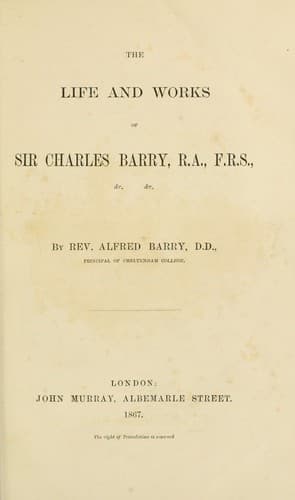
The life and works of Sir Charles BarryBarry, Alfred
General
The life and works of Sir Charles Barry
Barry, Alfred
Architects -- Great Britain -- Biography; Barry, Charles, 1795-1860
Such is a brief record of the chief of his general public actions; many
others there must have been, which have left no trace. He was one of
those busy men, who can always find time and thought for subjects
cognate to their own special work, though not directly connected with
it. When, therefore, he was gone, his loss was felt, in this as in other
relations of life, as removing one influence of suggestive originality
and of practical soberness of judgment.
CHAPTER X.
PRIVATE LIFE AND DEATH.
Leading events of his life--General habits of work--Domesticity and
privacy of life--Acquaintances and friendships--Distaste of
publicity--Leading features of character--Personal
appearance--Failure of health--Death--Funeral in Westminster
Abbey--Erection of Memorial Statue--Conclusion.
The story of Sir Charles Barry’s life has in great measure been told in
the description of his general architectural work. For that work he
lived; and in it he found not only the occupation, but also most of the
pleasures, of his life. It is hard for those who knew and loved him best
to dissociate his memory from the recollections of his ungrudging labour
upon it, and its never-flagging interest to him. It will therefore be
necessary in this concluding chapter to give only a brief notice of his
private life and character, and a short narrative of his death and
funeral. There are many private details, treasured in the most sacred
memories of home, which would be out of place in a published biography.
Its proper record is of facts, which have general interest; of work,
which produces lasting effects; of character, so far as that character
bears upon public action and has its universal lesson.
The events of his private life were few and simple. It is said that a
nation is happy if its annals be dull: he was certainly fortunate in the
fact, that his domestic annals were singularly uneventful; he had few
troubles and difficulties, except those connected with his professional
career. In the eyes of the world his course appeared to be one of
uninterrupted and increasing prosperity. He spent the whole of his life
in London, moving in 1827 from his first house in Ely Place, to 27,
Foley Place, where his chief designs (including that for the New Palace
at Westminster) were made; thence in 1841 to 32, Great George Street, in
order to be near his great work while in progress; and lastly to Clapham
Common, when he began to retire in some degree from his more active
professional work.[119]
He never cared to leave London, except for business or for brief
recreation. A short summer run was all that he needed, and there was
perhaps some want of repose in his character, which prevented his caring
for a country life. All his interests were in town; he rejoiced in its
bustle and society; and nothing would have compensated him for a
banishment from it.
Public-domain text, read in full here on John Shaqi.
Reviews
Reviews
No reviews yet
Be the first to share your thoughts on this work.
Elsewhere in the archive
Join the Discussion
Join the discussion
Sign in to leave a comment or review.
Sign InorCreate an account