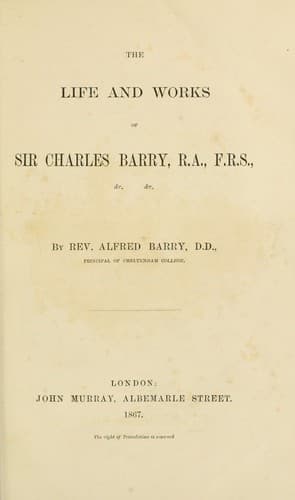
The life and works of Sir Charles BarryBarry, Alfred
General
The life and works of Sir Charles Barry
Barry, Alfred
Architects -- Great Britain -- Biography; Barry, Charles, 1795-1860
His life was pre-eminently a life of work, but work which had in it,
generally speaking, no flurry or painful anxiety--work, in fact, which
seemed a delight and almost a necessity. He always rose early; seldom
later than six o’clock, and often at four or five. He did so naturally
and habitually; in this habit probably lay much of the secret of his
freshness in work and freedom from all feverish and restless
excitability, even at his busiest and most anxious times. Whatever his
troubles or occupations might be, he could always fall asleep at night,
and, thanks to his excellent constitution, sleep was to him sound and
refreshing. But, as soon as nature was satisfied, the mind resumed its
activity, and in the early hours of morning there came back the whole
flood of anxieties and conceptions, which defied the power of sleep and
demanded immediate execution. It was well that this was his habit,
excepting when, in times of great excitement or difficulty, it led him
to overtask his strength. For in the time of his fullest work these
morning hours were the only ones, on which he could reckon with
certainty, and to these he traced many of the best of his ideas. He
experienced to the full, what most early risers know, that some of the
brightest thoughts belong to the very hour of waking, often solving in
the first freshness of the morning a difficulty, which had perplexed or
conquered him over-night. At all times, but in those morning hours
particularly, his rapidity of execution was something marvellous. He
himself was hardly conscious of any unusual power in this respect, and
would expect of others what he felt that he could do himself. Of trouble
he was utterly unsparing: he would think nothing of sponging out a whole
elevation, if an idea occurred to him, by which he thought that it could
be improved, even in details. Of any principal feature of a great work
the number of designs would be almost endless. Like most hard workers,
he was to a great extent superior to interruption. In fact, for the most
part he liked society during the time of his work. He would even listen
to reading, or join in conversation, without allowing the secondary
currents thus generated to interfere with the main stream of thought.
The interruptions of business or necessity never seemed to break the
thread of his ideas; seldom to flurry or discompose him. For he had this
mark of readiness and clearness of conception, that he was capable, on
the one hand, of setting to work at any moment, and resuming it, after
interruption, just as if no interruption had occurred, and capable, on
the other, of throwing it all aside at proper times, and joining in
recreation or social intercourse with all the lightheartedness of a
schoolboy. But for this readiness and elasticity of mind he could never
have gone through the extraordinary amount of labour, which came upon
him daily for many years.
Public-domain text, read in full here on John Shaqi.
Reviews
Reviews
No reviews yet
Be the first to share your thoughts on this work.
Elsewhere in the archive
Join the Discussion
Join the discussion
Sign in to leave a comment or review.
Sign InorCreate an account