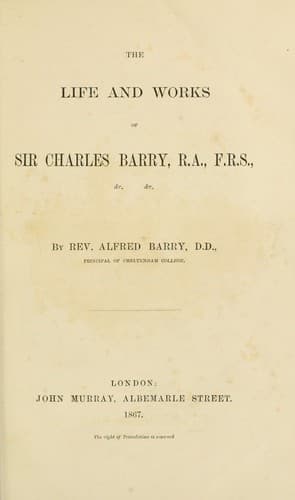
The life and works of Sir Charles BarryBarry, Alfred
General
The life and works of Sir Charles Barry
Barry, Alfred
Architects -- Great Britain -- Biography; Barry, Charles, 1795-1860
On the general method of that work something has been already quoted (on
page 86), from the words of one eminently qualified to judge. It
frequently happened (it was so in the case of the design for the New
Palace at Westminster), that the first sketch, which he made, contained
all the essential features of the design as actually carried out. Such
sketches, however, were eminently artistic in effect, and they would
have been even apt to mislead, had they not been immediately brought to
the test of accurate scale-drawing, and enlarged details. When this was
done, either by his own hand or by the hands of others, the task of
modification and alteration would begin, generally, however, tending
after much labour to realise more fully and perfectly the conceptions at
first roughly shadowed out. Occasionally it was otherwise, especially
in later years, when it can hardly be doubted that his fastidiousness of
taste became excessive, leading to alterations, sometimes almost
inconsistent with the original design, and securing minute improvements
at too high a cost. But his most successful works were those in which
the original idea predominated to the last; for they naturally had both
the unity of original conception, and the effect of careful study in
every detail.
His tendency was perhaps to do too much for himself, and to delegate too
little of important work to the many who would have gladly helped him.
If he did delegate anything, he was impatient to have it finished; and
what Sir Charles expected to be done in “a couple of hours” became a
proverb in his office. But it was hard to complain of one who never
spared himself, and there were few who did not learn energy and actual
delight in work under the shadow of his example. In spite, therefore, of
the extent of his requirements and of a very determined will, which he
never allowed to be questioned, he always met with cheerful and ready
help, and there arose up among his assistants a strong _esprit de
corps_, not without enthusiasm for their chief.[120]
The early mornings till breakfast time, and the evening hours from eight
o’clock till (at the earliest) eleven or twelve, were devoted to the
drawing-board; the day from ten to five to superintendence of buildings
in progress and to various business. This was his regular work; but
during the time of the preparation of the competition drawings for the
New Palace he hardly gave himself more than four or five hours’ sleep
out of the twenty-four. Work, however, simply as work, never seemed to
overtask his powers; it was not till anxieties and disappointments were
added to it, that he began to feel the strain. It was rare, even when
his strength began to fail, that he complained of its pressure: it
seemed to him the natural object of life, and in it certainly lay for
him the secret of happiness as well as success.
Public-domain text, read in full here on John Shaqi.
Reviews
Reviews
No reviews yet
Be the first to share your thoughts on this work.
Elsewhere in the archive
Join the Discussion
Join the discussion
Sign in to leave a comment or review.
Sign InorCreate an account