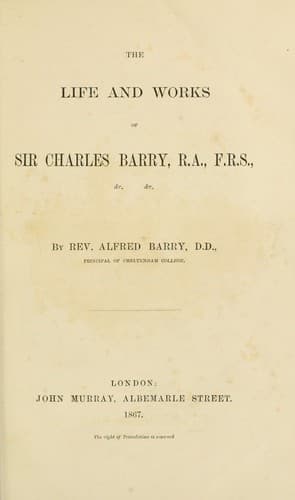
The life and works of Sir Charles BarryBarry, Alfred
General
The life and works of Sir Charles Barry
Barry, Alfred
Architects -- Great Britain -- Biography; Barry, Charles, 1795-1860
His habits of life were simple and domestic. He lived very much at home
in the society of his wife and children, especially during the later
years of his life. That home was pervaded by the spirit of intellectual
work and energy which distinguishes the homes of professional men, and
all its inmates felt the direct influence of its architectural
atmosphere. Of his sons, two, Charles and Edward, followed his own
profession. The former was at work independently, and the latter acted
as his coadjutor, till he began to retire from the more active exercise
of his profession. Their career he watched with peculiar interest, and
his advice and aid were always at their command. In their names he sent
in his last great architectural design,--the Plan of the Westminster
Improvements, elsewhere referred to. Of his other sons, two, Godfrey
and John, were engaged, the one in surveying, the other in engineering
work, and so followed paths of life not wholly different to his own. So
far therefore his family life still reflected something of the
professional thought and feeling, which elsewhere absorbed his interest.
But into any successes, which his sons achieved, he entered with a
special liveliness of satisfaction, and his home relations were those of
almost unbroken happiness and affection.
But although this was the case, few men had less of a recluse character.
His mind was singularly open to favourable impressions of strangers, and
his own free and genial manner tended to draw them to him, and elicit
their most attractive qualities. His judgment of character was certainly
not severe or critical, and he occasionally suffered much from taking
men at their own valuation.
To young artists, especially to young architects, he was always ready to
show appreciation and kindness. In their case he laid aside the severity
of criticism, which he indulged in relation to the works of established
reputation: he was rather inclined to overrate incipient talent, and was
always glad to meet it with encouragement and advice.
But indeed any stranger who presented himself, as an unappreciated
artist or an unknown discoverer, was sure of a favourable reception.
Foreigners especially made their way with him, for he always liked the
greater freedom and liveliness of Continental manners and character.
This openness to influence remained in him to the last, very little
corrected by experience, pushed even to the verge of credulity, often
leading him into positions which had a tendency to compromise
himself.[121] It is almost needless to add, that it was taken advantage
of by unscrupulous persons, who received help and benefit from him in
the time of urgent need, and turned afterwards to vilify the giver.
Public-domain text, read in full here on John Shaqi.
Reviews
Reviews
No reviews yet
Be the first to share your thoughts on this work.
Elsewhere in the archive
Join the Discussion
Join the discussion
Sign in to leave a comment or review.
Sign InorCreate an account