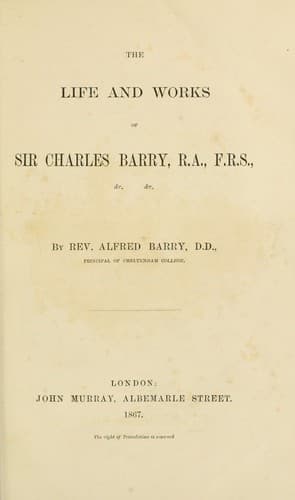
The life and works of Sir Charles BarryBarry, Alfred
General
The life and works of Sir Charles Barry
Barry, Alfred
Architects -- Great Britain -- Biography; Barry, Charles, 1795-1860
But although he was thus accessible to strangers, although no one could
enjoy more the change and relaxation of society, and although he had
many acquaintances in all ranks of life, he had few friends: with their
society, added to that of his own family, he was perfectly contented.
Perhaps with only one friend (Mr. Wolfe) had he any great and constant
intimacy, for with him he could share the one great interest which
absorbed his thoughts. Night after night Mr. Wolfe would spend with him,
while the work of design was going on, always ready to give
encouragement, suggestion, and criticism. And this community of artistic
interest naturally developed itself into a general community of thought
and feeling, not uncommon in youth, but rarely preserved in manhood and
age.
Connected with these traits of character was a great, and (I think) an
excessive, dislike of all public display. He had a keener sense of the
conventionality and hollowness, which generally attach to it, than of
the substantial reality, on which after all it must be based, or of the
important functions which it performs. It was difficult to induce him to
take, on any public occasion, the part required of him, by his
connection with public bodies or by his own professional position; he
shrank from the necessity of a speech or a lecture, even on subjects on
which he might have spoken with authority.
It is probable that this feature of his character was inseparably
connected with his energy of work and eminently practical tastes; but it
was certainly unfortunate in its effects. It isolated him greatly from
his professional brethren, and this isolation, on the one hand,
prevented his exercising the full influence of his position, and on the
other, deprived him of an interchange of thought and opinion, which
might have told with advantage upon his own mind. The effect of this
isolation perhaps increased as time went on, when new styles were rising
up in architecture, and much of the work, to which his life had been
devoted, was disparaged or decried. He was not indeed shaken in his old
architectural creed; he believed that, in spite of the originality and
talent displayed in the rising generation of architects, there was in
much of their work a violation of first principles, which would
eventually be felt as fatal. This conviction, and the natural vigour and
buoyancy of his character, enabled him to show a bold front to all
attacks, and go on, in disregard of them, in the path which he thought
the right one. But he nevertheless felt them keenly. Like most men of
high spirits, he was subject to periods of depression, which told more
on his constitution than any amount of labour. And at such times,
although, as has been seen, he received the most generous support from
the members of his profession, he could but feel that in some respects
he stood alone.
Such was the general tenour of his life, which at once reflected his
natural character, and reacted upon it.
Public-domain text, read in full here on John Shaqi.
Reviews
Reviews
No reviews yet
Be the first to share your thoughts on this work.
Elsewhere in the archive
Join the Discussion
Join the discussion
Sign in to leave a comment or review.
Sign InorCreate an account