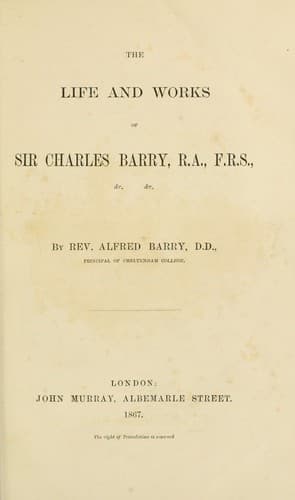
The life and works of Sir Charles BarryBarry, Alfred
General
The life and works of Sir Charles Barry
Barry, Alfred
Architects -- Great Britain -- Biography; Barry, Charles, 1795-1860
It must, of course, be left to others to pronounce on his artistic
qualities, and to judge of the results which they produced. But it may
be well to refer to the intellectual characteristics by which his mind
seemed pre-eminently distinguished. One was a remarkable quickness of
conception, which was intuitive on his own subjects, but which did not
fail him even upon others. This quickness occasionally appeared to
supersede any long abstract study. Not indeed that he would not spend
infinite pains in maturing his conception, but these were given to
practical developments and variations, which might be what
mathematicians call “Formulas of Verification,” rather than to search
for authorities and abstract reflection upon principles. I imagine that
such half-unconscious intuition is characteristic of the artistic
temperament, and doubt whether even Shakspere or Turner grasped, in
abstract theory, those principles, which have been most truly discovered
and commented upon in their works.
Joined to this quickness there was in him a remarkable fertility of
design and contrivance. If a plan proved impracticable, if a design was
rejected, the failure never seemed to disconcert him. Like the English
infantry, he “never knew when he was beaten,” and his scattered forces
were rallied instantly to another attack. This fertility was stimulated
by an indestructible power of taking interest in the minutest details,
and of despising all trouble in the search after perfection, whether it
were in the design of a Victoria Tower, or the alteration and
realteration of a drawing-room drapery. And it was perhaps supported by
that resolution to have his own way, good humoured but determined, of
which he was not untruly accused. For he was entirely, almost amusingly,
unconscious that it had anything to do with any personal characteristic
or any assertion of individual will. It seemed to him to be dictated by
an artistic necessity, so strong that it was hardly possible to oppose
it. The very readiness with which the ideas occurred seemed to him a
guarantee that they were reasonable and almost self-evident, and why
they did not occur to others, or why, when suggested, they did not
commend themselves to others, he could not understand.
With these characteristics were naturally united a sanguine disposition
and a quick temper. That sanguineness was of course tempered, and even
over-clouded, by experience of life, and it had its period of natural
reaction, when all things seemed gloomy to him, and he would pronounce
his own powers a mere pretence and his life a failure. These periods
acted upon, and suffered reaction from, his bodily health, and in them
work was his best relief. Some excitability of temper belongs to such
disposition, but there were few whom one could more truly describe as
“Irasci celerem, tamen ut placabilis esset.”
Public-domain text, read in full here on John Shaqi.
Reviews
Reviews
No reviews yet
Be the first to share your thoughts on this work.
Elsewhere in the archive
Join the Discussion
Join the discussion
Sign in to leave a comment or review.
Sign InorCreate an account