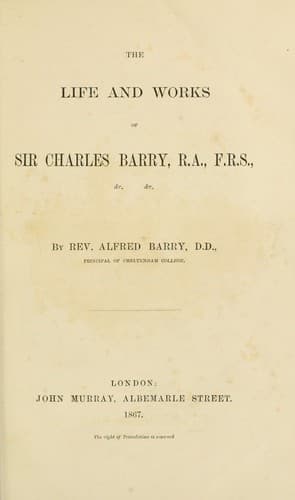
The life and works of Sir Charles BarryBarry, Alfred
General
The life and works of Sir Charles Barry
Barry, Alfred
Architects -- Great Britain -- Biography; Barry, Charles, 1795-1860
For openness and geniality were leading characteristics in his mind. He
delighted in society, and in society of men of all characters and
occupations; and those who do this are not likely to treasure up morbid
views of men or of actions.
Closely connected indeed with this excitability was his appreciation of
fun and even good-humoured mischief, and his power of entering into
interests, trivial or sportive in themselves. He would take trouble and
show eagerness, even in the amusements of his home circle, and be
anxious that they should be carried out in the best possible way. And,
even to the last, he preserved much of the impulsive freshness and
youthfulness of his character, without any sign of the narrowing and
chilling influence of age.
But these qualities in him were not exaggerated into exclusive
prominence. The imaginative and the practical, the powers of sanguine
impulse and prudential action in detail, were remarkably blended in his
mind. Thus he was on the one hand emphatically an artist. Before all
things he placed the power of imagination and creation, the sense of
beauty, and the reverence for Art which could minister to that sense, in
all the forms which it assumed, in painting, sculpture, and music, as
well as in architecture. I think indeed that he required the æsthetic
influence to clothe itself in visible artistic form; for the beauty of
Nature in itself, and the forms of the imagination clothed merely in the
words of poetry, were not the influences which laid strongest hold upon
his mind. But the claims of Art were paramount, and the realisation of
what was beautiful in it was to him the chief good, independent of all
other results. Yet, on the other hand, he was emphatically a “man of
business;” he had all the power of quick practical observation,
clearness and decision in details, willingness to accept the necessity
of prosaic work and drudgery, which belong to this character. The two
elements in his mind harmonized, and did not clash with each other.
In the same way he was impulsive and almost rash, in the ventures he
would make, and the risks he would run. The spirit of “speculation”
might easily have been developed in him, even to a dangerous prominence.
Difficulties he not only made light of, but he was often incapable of
perceiving their full force, if it would have been fatal to a cherished
idea. Yet in his execution of his schemes he could bring into play the
powers of good sense, caution, and watchfulness, to make sure of every
step, and to prevent divergence into the shadowy regions of the
impracticable.
Public-domain text, read in full here on John Shaqi.
Reviews
Reviews
No reviews yet
Be the first to share your thoughts on this work.
Elsewhere in the archive
Join the Discussion
Join the discussion
Sign in to leave a comment or review.
Sign InorCreate an account