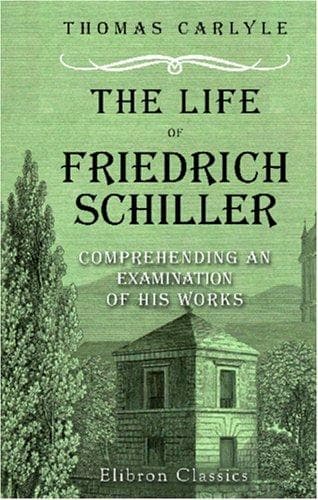
The Life of Friedrich Schiller: Comprehending an Examination of His Works — John Shaqi
The Life of Friedrich Schiller: Comprehending an Examination of His WorksCarlyle, Thomas
General
The Life of Friedrich Schiller: Comprehending an Examination of His Works
Carlyle, Thomas
Authors, German -- 18th century -- Biography; Schiller, Friedrich, 1759-1805; Schubart, Christian Friedrich Daniel, 1739-1791
Similar defects are visible in almost all the other characters. Moor,
the father, is a weak and fond old man, who could have arrived at gray
hairs in such a state of ignorance nowhere but in a work of fiction.
The inferior banditti are painted with greater vigour, yet still in
rugged and ill-shapen forms; their individuality is kept up by an
extravagant exaggeration of their several peculiarities. Schiller
himself pronounced a severe but not unfounded censure, when he said of
this work, in a maturer age, that his _chief_ fault was in 'presuming
to delineate men two years before he had met one.'
His skill in the art of composition surpassed his knowledge of the
world; but that too was far from perfection. Schiller's style in the
_Robbers_ is partly of a kind with the incidents and feelings which it
represents; strong and astonishing, and sometimes wildly grand; but
likewise inartificial, coarse, and grotesque. His sentences, in their
rude emphasis, come down like the club of Hercules; the stroke is
often of a crushing force, but its sweep is irregular and awkward.
When Moor is involved in the deepest intricacies of the old question,
necessity and free will, and has convinced himself that he is but an
engine in the hands of some dark and irresistible power, he cries out:
"Why has my Perillus made of me a brazen bull to roast men in my
glowing belly?" The stage-direction says, 'shaken with horror:' no
wonder that he shook!
Schiller has admitted these faults, and explained their origin, in
strong and sincere language, in a passage of which we have already
quoted the conclusion. 'A singular miscalculation of nature,' he says,
'had combined my poetical tendencies with the place of my birth. Any
disposition to poetry did violence to the laws of the institution
where I was educated, and contradicted the plan of its founder. For
eight years my enthusiasm struggled with military discipline; but the
passion for poetry is vehement and fiery as a first love. What
discipline was meant to extinguish, it blew into a flame. To escape
from arrangements that tortured me, my heart sought refuge in the
world of ideas, when as yet I was unacquainted with the world of
realities, from which iron bars excluded me. I was unacquainted with
men; for the four hundred that lived with me were but repetitions of
the same creature, true casts of one single mould, and of that very
mould which plastic nature solemnly disclaimed. * * * Thus
circumstanced, a stranger to human characters and human fortunes, to
hit the medium line between angels and devils was an enterprise in
which I necessarily failed. In attempting it, my pencil necessarily
brought out a monster, for which by good fortune the world had no
original, and which I would not wish to be immortal, except to
perpetuate an example of the offspring which Genius in its unnatural
union with Thraldom may give to the world. I allude to the
_Robbers_.'[5]
Public-domain text, read in full here on John Shaqi.
Reviews
Reviews
No reviews yet
Be the first to share your thoughts on this work.
Join the Discussion
Join the discussion
Sign in to leave a comment or review.
Sign InorCreate an account