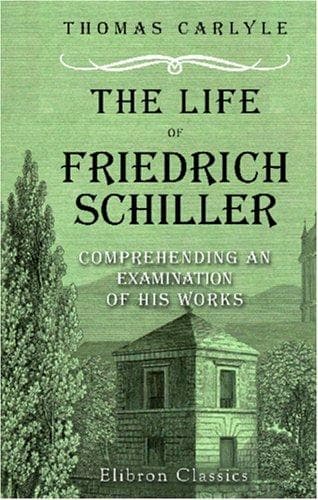
The Life of Friedrich Schiller: Comprehending an Examination of His WorksCarlyle, Thomas
General
The Life of Friedrich Schiller: Comprehending an Examination of His Works
Carlyle, Thomas
Authors, German -- 18th century -- Biography; Schiller, Friedrich, 1759-1805; Schubart, Christian Friedrich Daniel, 1739-1791
With the appearance of _Fiesco_ and its companion, the first period of
Schiller's literary history may conclude. The stormy confusions of his
youth were now subsiding; after all his aberrations, repulses, and
perplexed wanderings, he was at length about to reach his true
destination, and times of more serenity began to open for him. Two
such tragedies as he had lately offered to the world made it easier
for his friend Dalberg to second his pretensions. Schiller was at last
gratified by the fulfilment of his favourite scheme; in September
1783, he went to Mannheim, as poet to the theatre, a post of
respectability and reasonable profit, to the duties of which he
forthwith addressed himself with all his heart. He was not long
afterwards elected a member of the German Society established for
literary objects in Mannheim; and he valued the honour, not only as a
testimony of respect from a highly estimable quarter, but also as a
means of uniting him more closely with men of kindred pursuits and
tempers: and what was more than all, of quieting forever his
apprehensions from the government at Stuttgard. Since his arrival at
Mannheim, one or two suspicious incidents had again alarmed him on
this head; but being now acknowledged as a subject of the Elector
Palatine, naturalised by law in his new country, he had nothing more
to fear from the Duke of Würtemberg.
Satisfied with his moderate income, safe, free, and surrounded by
friends that loved and honoured him, Schiller now looked confidently
forward to what all his efforts had been a search and hitherto a
fruitless search for, an undisturbed life of intellectual labour. What
effect this happy aspect of his circumstances must have produced upon
him may be easily conjectured. Through many years he had been inured
to agitation and distress; now peace and liberty and hope, sweet in
themselves, were sweeter for their novelty. For the first time in his
life, he saw himself allowed to obey without reluctance the ruling
bias of his nature; for the first time inclination and duty went hand
in hand. His activity awoke with renovated force in this favourable
scene; long-thwarted, half-forgotten projects again kindled into
brightness, as the possibility of their accomplishment became
apparent: Schiller glowed with a generous pride when he felt his
faculties at his own disposal, and thought of the use he meant to make
of them. 'All my connexions,' he said, 'are now dissolved. The public
is now all to me, my study, my sovereign, my confidant. To the public
alone I henceforth belong; before this and no other tribunal will I
place myself; this alone do I reverence and fear. Something majestic
hovers before me, as I determine now to wear no other fetters but the
sentence of the world, to appeal to no other throne but the soul of
man.'
Public-domain text, read in full here on John Shaqi.
Reviews
Reviews
No reviews yet
Be the first to share your thoughts on this work.
Join the Discussion
Join the discussion
Sign in to leave a comment or review.
Sign InorCreate an account