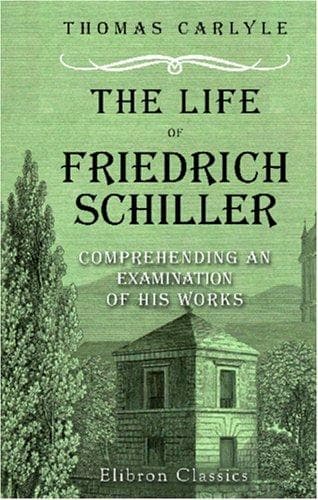
The Life of Friedrich Schiller: Comprehending an Examination of His WorksCarlyle, Thomas
General
The Life of Friedrich Schiller: Comprehending an Examination of His Works
Carlyle, Thomas
Authors, German -- 18th century -- Biography; Schiller, Friedrich, 1759-1805; Schubart, Christian Friedrich Daniel, 1739-1791
These expressions are extracted from the preface to his _Thalia_, a
periodical work which he undertook in 1784, devoted to subjects
connected with poetry, and chiefly with the drama. In such sentiments
we leave him, commencing the arduous and perilous, but also glorious
and sublime duties of a life consecrated to the discovery of truth,
and the creation of intellectual beauty. He was now exclusively what
is called a _Man of Letters_, for the rest of his days.
PART II.
FROM SCHILLER'S SETTLEMENT AT MANNHEIM TO HIS SETTLEMENT AT JENA.
(1783-1790.)
PART SECOND.
[1783-1790.]
If to know wisdom were to practise it; if fame brought true dignity
and peace of mind; or happiness consisted in nourishing the intellect
with its appropriate food and surrounding the imagination with ideal
beauty, a literary life would be the most enviable which the lot of
this world affords. But the truth is far otherwise. The Man of Letters
has no immutable, all-conquering volition, more than other men; to
understand and to perform are two very different things with him as
with every one. His fame rarely exerts a favourable influence on his
dignity of character, and never on his peace of mind: its glitter is
external, for the eyes of others; within, it is but the aliment of
unrest, the oil cast upon the ever-gnawing fire of ambition,
quickening into fresh vehemence the blaze which it stills for a
moment. Moreover, this Man of Letters is not wholly made of spirit,
but of clay and spirit mixed: his thinking faculties may be nobly
trained and exercised, but he must have affections as well as thoughts
to make him happy, and food and raiment must be given him or he dies.
Far from being the most enviable, his way of life is perhaps, among
the many modes by which an ardent mind endeavours to express its
activity, the most thickly beset with suffering and degradation. Look
at the biography of authors! Except the Newgate Calendar, it is the
most sickening chapter in the history of man. The calamities of these
people are a fertile topic; and too often their faults and vices have
kept pace with their calamities. Nor is it difficult to see how this
has happened. Talent of any sort is generally accompanied with a
peculiar fineness of sensibility; of genius this is the most essential
constituent; and life in any shape has sorrows enough for hearts so
formed. The employments of literature sharpen this natural tendency;
the vexations that accompany them frequently exasperate it into morbid
soreness. The cares and toils of literature are the business of life;
its delights are too ethereal and too transient to furnish that
perennial flow of satisfaction, coarse but plenteous and substantial,
of which happiness in this world of ours is made. The most finished
efforts of the mind give it little pleasure, frequently they give it
Public-domain text, read in full here on John Shaqi.
Reviews
Reviews
No reviews yet
Be the first to share your thoughts on this work.
Join the Discussion
Join the discussion
Sign in to leave a comment or review.
Sign InorCreate an account