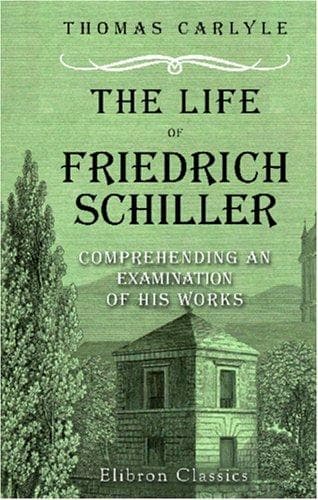
The Life of Friedrich Schiller: Comprehending an Examination of His WorksCarlyle, Thomas
General
The Life of Friedrich Schiller: Comprehending an Examination of His Works
Carlyle, Thomas
Authors, German -- 18th century -- Biography; Schiller, Friedrich, 1759-1805; Schubart, Christian Friedrich Daniel, 1739-1791
professional employments left him leisure; on a subject connected with
the latter he became an author.[2] But what chiefly distinguished him
was the practice of a sincere piety, which seems to have diffused
itself over all his feelings, and given to his clear and honest
character that calm elevation which, in such a case, is its natural
result. As his religion mingled itself with every motive and action of
his life, the wish which in all his wanderings lay nearest his heart,
the wish for the education of his son, was likely to be deeply
tinctured with it. There is yet preserved, in his handwriting, a
prayer composed in advanced age, wherein he mentions how, at the
child's birth, he had entreated the great Father of all, "to supply in
strength of spirit what must needs be wanting in outward instruction."
The gray-haired man, who had lived to see the maturity of his boy,
could now express his solemn thankfulness, that "God had heard the
prayer of a mortal."
[Footnote 1: She was of humble descent and little education,
the daughter of a baker in Kodweis.]
[Footnote 2: His book is entitled _Die Baumzucht im Grossen_
(the Cultivation of Trees on the Grand Scale): it came to a
second edition in 1806.]
Friedrich followed the movements of his parents for some time; and had
to gather the elements of learning from various masters. Perhaps it
was in part owing to this circumstance, that his progress, though
respectable, or more, was so little commensurate with what he
afterwards became, or with the capacities of which even his earliest
years gave symptoms. Thoughtless and gay, as a boy is wont to be, he
would now and then dissipate his time in childish sports, forgetful
that the stolen charms of ball and leapfrog must be dearly bought by
reproaches: but occasionally he was overtaken with feelings of deeper
import, and used to express the agitations of his little mind in words
and actions, which were first rightly interpreted when they were
called to mind long afterwards. His schoolfellows can _now_ recollect
that even his freaks had sometimes a poetic character; that a certain
earnestness of temper, a frank integrity, an appetite for things grand
or moving, was discernible across all the caprices of his boyhood.
Once, it is said, during a tremendous thunderstorm, his father missed
him in the young group within doors; none of the sisters could tell
what was become of Fritz, and the old man grew at length so anxious
that he was forced to go out in quest of him. Fritz was scarcely past
the age of infancy, and knew not the dangers of a scene so awful. His
father found him at last, in a solitary place of the neighbourhood,
perched on the branch of a tree, gazing at the tempestuous face of the
sky, and watching the flashes as in succession they spread their lurid
gleam over it. To the reprimands of his parent, the whimpering truant
pleaded in extenuation, "that the lightning was very beautiful, and
Public-domain text, read in full here on John Shaqi.
Reviews
Reviews
No reviews yet
Be the first to share your thoughts on this work.
Join the Discussion
Join the discussion
Sign in to leave a comment or review.
Sign InorCreate an account