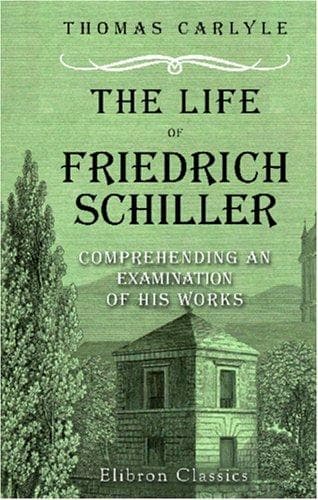
The Life of Friedrich Schiller: Comprehending an Examination of His WorksCarlyle, Thomas
General
The Life of Friedrich Schiller: Comprehending an Examination of His Works
Carlyle, Thomas
Authors, German -- 18th century -- Biography; Schiller, Friedrich, 1759-1805; Schubart, Christian Friedrich Daniel, 1739-1791
creamless region, bestowing with the same solemnity his
blessing on the one which had afforded him that savoury
refreshment.' _Friedrich von Schillers Leben_ (Heidelberg.
1817), p. 11.]
This good hope was not, however, destined to be realised in the way
they expected: accidents occurred which changed the direction of
Schiller's exertions, and threatened for a time to prevent the success
of them altogether. The Duke of Würtemberg had lately founded a Free
Seminary for certain branches of professional education: it was first
set up at Solitude, one of his country residences; and had now been
transferred to Stuttgard, where, under an improved form, and with the
name of _Karls-schule_, we believe it still exists. The Duke proposed
to give the sons of his military officers a preferable claim to the
benefits of this institution; and having formed a good opinion both of
Schiller and his father, he invited the former to profit by this
opportunity. The offer occasioned great embarrassment: the young man
and his parents were alike determined in favour of the Church, a
project with which this new one was inconsistent. Their embarrassment
was but increased, when the Duke, on learning the nature of their
scruples, desired them to think well before they decided. It was out
of fear, and with reluctance that his proposal was accepted. Schiller
enrolled himself in 1773; and turned, with a heavy heart, from
freedom and cherished hopes, to Greek, and seclusion, and Law.
His anticipations proved to be but too just: the six years which he
spent in this establishment were the most harassing and comfortless of
his life. The Stuttgard system of education seems to have been formed
on the principle, not of cherishing and correcting nature, but of
rooting it out, and supplying its place with something better. The
process of teaching and living was conducted with the stiff formality
of military drilling; every thing went on by statute and ordinance,
there was no scope for the exercise of free-will, no allowance for the
varieties of original structure. A scholar might possess what
instincts or capacities he pleased; the 'regulations of the school'
took no account of this; he must fit himself into the common mould,
which, like the old Giant's bed, stood there, appointed by superior
authority, to be filled alike by the great and the little. The same
strict and narrow course of reading and composition was marked out for
each beforehand, and it was by stealth if he read or wrote any thing
beside. Their domestic economy was regulated in the same spirit as
their preceptorial: it consisted of the same sedulous exclusion of all
that could border on pleasure, or give any exercise to choice. The
pupils were kept apart from the conversation or sight of any person
but their teachers; none ever got beyond the precincts of despotism to
snatch even a fearful joy; their very amusements proceeded by the word
of command.
Public-domain text, read in full here on John Shaqi.
Reviews
Reviews
No reviews yet
Be the first to share your thoughts on this work.
Join the Discussion
Join the discussion
Sign in to leave a comment or review.
Sign InorCreate an account