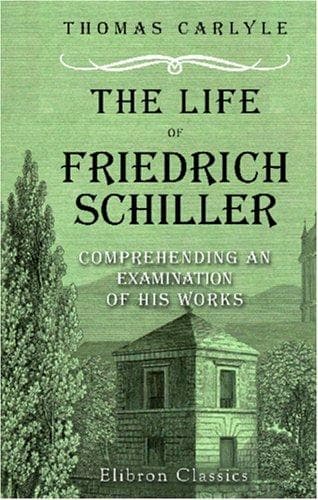
The Life of Friedrich Schiller: Comprehending an Examination of His Works — John Shaqi
The Life of Friedrich Schiller: Comprehending an Examination of His WorksCarlyle, Thomas
General
The Life of Friedrich Schiller: Comprehending an Examination of His Works
Carlyle, Thomas
Authors, German -- 18th century -- Biography; Schiller, Friedrich, 1759-1805; Schubart, Christian Friedrich Daniel, 1739-1791
him with their severities; yet still there was a negligent success in
his attempts, which, joined to his honest and vivid temper, made men
augur well of him. The Stuttgard Examinators have marked him in their
records with the customary formula of approval, or, at worst, of
toleration. They usually designate him as 'a boy of good hope,' _puer
bonæ spei_.
[Footnote 3: The first display of his poetic gifts occurred
also in his ninth year, but took its rise in a much humbler
and less common source than the inspiration of the stage. His
biographers have recorded this small event with a
conscientious accuracy, second only to that of Boswell and
Hawkins in regard to the Lichfield _duck_. 'The little tale,'
says one of them, 'is worth relating; the rather that, after
an interval of more than twenty years, Schiller himself, on
meeting with his early comrade (the late Dr. Elwert of
Kantstadt) for the first time since their boyhood, reminded
him of the adventure, recounting the circumstances with great
minuteness and glee. It is as follows: Once in 1768, Elwert
and he had to repeat their catechism together on a certain
day publicly in the church. Their teacher, an
ill-conditioned, narrow-minded pietist, had previously
threatened them with a thorough flogging if they missed even
a single word. To make the matter worse, this very teacher
chanced to be the person whose turn it was to catechise on
the appointed day. Both the boys began their answers with
dismayed hearts and faltering tongues; yet they succeeded in
accomplishing the task; and were in consequence rewarded by
the mollified pedagogue with two kreutzers apiece. Four
kreutzers of ready cash was a sum of no common magnitude; how
it should be disposed of formed a serious question for the
parties interested. Schiller moved that they should go to
Harteneck, a hamlet in the neighbourhood, and have a dish of
curds-and-cream: his partner assented; but alas! in Harteneck
no particle of curds or cream was to be had. Schiller then
made offer for a quarter-cake of cheese; but for this four
entire kreutzers were demanded, leaving nothing whatever in
reserve for bread! Twice baffled, the little gastronomes,
unsatisfied in stomach, wandered on to Neckarweihingen;
where, at length, though not till after much inquiry, they
did obtain a comfortable mess of curds-and-cream, served up
in a gay platter, and silver spoons to eat it with. For all
this, moreover, they were charged but three kreutzers; so
that there was still one left to provide them with a bunch of
St. John grapes. Exhilarated by such liberal cheer, Schiller
rose into a glow of inspiration: having left the village, he
mounted with his comrade to the adjacent height, which
overlooks both Harteneck and Neckarweihingen; and there in a
truly poetic effusion he pronounced his malediction on the
Public-domain text, read in full here on John Shaqi.
Reviews
Reviews
No reviews yet
Be the first to share your thoughts on this work.
Join the Discussion
Join the discussion
Sign in to leave a comment or review.
Sign InorCreate an account